Transcript for Melissa Stockwell Interview on the Beyond Speaking Podcast
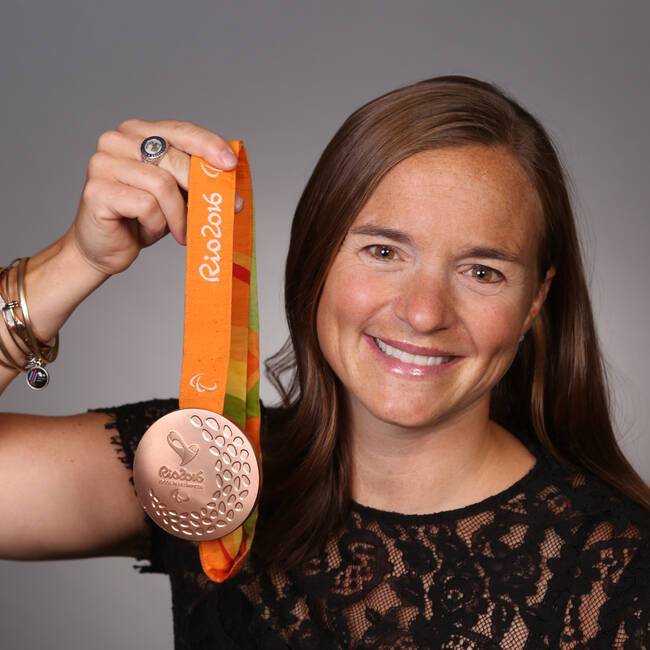
Melissa Stockwell, a former U.S. Army officer and Paralympian, shares her journey from joining the military out of love for her country to losing her leg in Iraq and then becoming a three-time world champion athlete. Melissa discusses her decision to join the Army, her experience and recovery after the injury, her transition into Paralympic sports, and her charity work with Dare2tri. The interview also highlights her unique approach to celebrating her “alive day,” the anniversary of her injury, by reflecting on life’s blessings.
Podcast Episode · Beyond Speaking · Aug 6, 2024 · 26m
Brian: We're excited to have on today Melissa Stockwell. Melissa served in the U.S. Army in Iraq, where she nearly made the ultimate sacrifice. She was the first woman to lose a limb in active combat, and for her services to our country, she was awarded the Bronze Star and Purple Heart. Since then, she's turned herself into a world champion athlete, in fact, a three-time world champion, competing in Beijing and Rio. She currently has her eye on competing in the Tokyo 2020 Paralympics. Melissa, thanks for coming on.
Melissa: Thanks for having me, I'm excited to be on.
Brian: Now you have a pretty amazing story. It's split into a few different parts. And it seems to start with the military. What made you decide to go into the military? Is it something you've always always dreamed about or where did that come from?
Melissa: So I decided I wanted to go into the military, my answer's pretty short and sweet, because I love our country. I learned at a young age how lucky we were to live here and decided that I wanted to give back and wear our uniform and kind of represent and defend a country that I felt so lucky to be a part of.
Brian: Now we have a lot of different speakers in different areas. What made you decide to choose the army out of the services?
Melissa: It was always the army. I am not sure why. I don't come from a military family, so it's not like my father was in the army and that was why. It just kind of when I wanted to join the military, the army just seemed like the natural choice to fall into.
Brian: So what is that process like when you join? Are you looking for a specific thing that you want to do in the army or what was your course and rise through the military?
Melissa: So I did ROTC in college, which basically means that I spent my sophomore, junior, and senior year taking courses that would teach me about the military and kind of everything that encompassed the military, everything from rankings to battle drills to, you know, the history and that type of thing. And when I graduated I was commissioned as a second lieutenant, so an officer into the army. And the army kind of ranks you or gives you choices on which branch and which part of the army you're gonna be a part of, but it's kind of where their need is as well. So I eventually fell into the transportation corps.
So I was in the transportation corps, part of the army, and then my first duty assignment was at Fort Hood, Texas, as part of the first cavalry division.
Brian: Now how long does it take to from when you go in and and and if you could also mention the years you're going in, but what's the time from going where you first sign up to when you actually start active duty maybe on foreign soil?
Melissa: You know, it kinda it kind of depends on the person and what route they go. So, I mean, personally, I was commissioned as an officer in 2002. I got my first duty assignment. About a year later, you kind of go through an officer basic course where you learn all the ins and outs. So for me, all the ins and outs of transportation and vehicles and leading a convoy.
I got to my first duty station at the end of 2003 and then we were deployed in March of 2004 over to Iraq. So it very much depends on the person, on the ways of the world. I mean, you know, some soldiers are in for ten years and never go over to combat or war zones. It just kinda depends on where the world is.
Brian: So how long were you there? I know we mentioned a little bit in the intro about how you know your life changed in one day. How long were you in the country before the incident or your loss occurred?
Melissa: So I was in Iraq for three weeks before I lost my leg. So pretty quick. Yeah. So for three weeks I was all over Iraq, with you know, with vehicles and leading convoys and then April thirteenth of two thousand four was the day everything changed and it was quick. I wasn't there very long.
Brian: So can you take us through that day?
Melissa: April 13, 2004, and it was basically a routine convoy. So I basically did convoys every day, leaving into this day and there wasn't anything super special about it. The difference in the day of April thirteenth is that typically I would lead the convoy, so I'd like sitting in the passenger seat next to the driver. But this day I was doing a ride along, which basically meant that I was learning the route because the next day I was gonna take over and lead that route.
So I was sitting behind the driver, but I didn't really have a role. Like I didn't really have a job that day other than just to learn the route. We left our base, our military base in Iraq that morning. And about 10 minutes into the ride, we went under this bridge, like under this underpass. And I mean, duffening boom and black smoke, the smell of metal. I mean, as we are basically our vehicle had been struck by a roadside bomb.
We swerved, our vehicles started to swerve, the windshield was cracked in. We kind of ricocheted off of this guardrail and we ended up ultimately crashing into this Iraqi woman's house. And, you know, to make what could be, you know, a long story pretty short, it resulted in the loss of my left leg above the knee. It was gone, it was severed through through the roadside bomb and the ricocheting off of the guardrail and that type of thing.
So yeah, I had a combat medic who was two vehicles back. he he saved my life. He stopped the bleeding, he put a tourniquet on. And then from there I was rushed into a life saving surgery at an American hospital, which was right in central Baghdad. So a pretty eventful day.
Brian: What was that recovery process like?
Melissa: So I spent just a few hours after that initial surgery in Iraq and then I flew to Launchfield, Germany, which you're kind of stabilized before making the long trip back to the US. So I was in Germany for about five days and then I ended up the following day at Walter Reed Army Medical Center, which at the time was in Washington DC and it was where all the wounded soldiers went from Iraq and Afghanistan.
So getting there and, you know, still a little bit out of it. But when I was, you know, another when a day another day or two went by, I was able to really look around me and see other soldiers who had lost, you know, much more than I had. So one, two, three limbs, their eyesight, traumatic brain injuries. And I looked at myself and thought, I mean, I was one of the lucky ones. I lost one leg. I had three good limbs, I had my life.
But I kind of, you know, accepted the loss then and chose to live my life for those who had given the ultimate sacrifice and not wanting to let losing a leg stop me from doing anything that I wanted to do.
Brian: So you know, we've talked a little bit about the physical aspect of it and you're just mentioning the mental aspect of choosing how are you going to do that. That's not the choice that everyone makes. Why do you think you chose to approach it that way?
Melissa: You know, I've always been a very optimistic person, probably annoyingly so for some people. But it almost accelerated it after losing my leg. And I mean, it was all about perspective also. I mean, I think in life, I mean, we all have these, we all have obstacles that we go through, some are bigger than others, but it's all relative to your own life. And, you know, when you think about your bad days, it's kind of the notion of realizing that there's somebody out there who would love to have my bad days. Like I have it pretty good.
So whenever I started to feel bad for myself, kind of looking around and realizing I couldn't feel bad for myself because it could have been so much worse. And on top of that, I had an amazing team. So my family, my friends, I mean my parents were by my side from day one. Friends that dropped everything they were doing to fly to the hospital to be by my side. So just the realization that I wasn't alone going through this, that there were people there with me who wanted me to get better.
Brian: Does the military itself have different things to kinda help people with a mental process of a severe injury like that?
Melissa: They do. So so at Walter Reed or at the military hospitals, you can imagine. I mean, nurses, doctors, therapists, I mean, I you know, you see them multiple times a week, I mean, every day. And there's also, I mean, there's psychologists, psychiatrists. I mean, the invisible wounds of war, as a lot of people call them, whether it's, you know, PTS or whatever it may be.
I mean, they're very real and the army, I mean, they do the best that they can to deal with the soldiers that are having issues. I mean, I think there are some that definitely go unnoticed and by the wayside, which is unfortunate. But I mean, while I was at Walter Reed and an inpatient, if I needed help it was there. So I had all the resources that I could ask for.
Brian: What advice would you give to people going through a really difficult time?
Melissa: It gets better. I mean, it's hard. Like you go through these horrible times and you're like, my life is never gonna be the same. It's never gonna be the way it used to be. And honestly, maybe it won't be the way that it used to be, but it doesn't mean it can't be as good.
So I like to tell people that to number one, find a team, find family, friends that can be your team, find others going through similar circumstances that you can lean on and you can rely on.
But also you have to believe in yourself. I mean you have to believe that you will be better. You have to, you know, have the perseverance to overcome whatever has come your way, knowing that you will be okay on the other side, and sometimes you're even better on the other side.
Brian: So your story is not just the military but as an athlete as well. What sports did you play? You know, obviously you went to the Olympics, or Paralympics for triathlon. Were you a triathlete as a kid?
Melissa: No, no, I don’t even think I knew what a triathlon was when I was younger. So definitely not a triathlete.
Brian: What did you start out playing or what was your sport starting out?
Melissa: Yeah, my sport was gymnastics. So I was a huge gymnast growing up. You know, I dreamt of going to the Olympics as a gymnast. I was in the gym 4+ hours a day. I kind of rose through the levels pretty quickly and was definitely called an Olympic Hopeful at one time. So gymnastics was my thing. I mean, I was a gymnast through and through when I was younger.
Brian: Do you feel like that helped you out in the military? I mean, that's a tremendous amount of discipline to be, especially a gymnast or anything where you're called an Olympic Hopeful. How did that play into your ability to be a soldier?
Melissa: You know, I think sometimes sports and military life, they kind of play off each other. I mean, you know, as an athlete growing up, I mean, you learn about team, you learn about doing your best, you learn about, you know, wanting to win and like to prove to yourself that you can be the best. So I think a lot of that kind of leads into those military values of you know, of team, of you know, being on time, of wanting to teach others or wanting to lead others. So I think a lot of them kinda play off of each other.
Brian: Who were some of your coaches growing up, and what did they teach you?
Melissa: So, I actually had an Olympic gymnast, Olga Corbett, from Russia who was one of my gymnastics coaches when I was a little bit younger, and she taught me what tough love was. I'm sure that that has played a part in the rest of my life. But I mean, if we you know, if we fell off the beam, I mean she told us to get back up. If we were on the bars and we had, you know, calluses and blisters and rips all over our hands, she said, you know, kinda like “Well, suck it up and get back on there because I mean it's you're not gonna get any better if you don't.” So I think as much as it might be hard at the time, I think I personally thrived on it and that kinda has helped me out in the rest of my life.
But you know, I mean I think sports in general, and the coaches I've had some amazing coaches, they've still kind of lifelong friends today, just showing I mean believing in you. I mean sometimes sometimes it's nice to have somebody who believes in you even more than you might believe in yourself.
Brian: As a competitive athlete, did you find that those leaders and mentors that you had in the military were similar at all, or how is that different between the military and sports?
Melissa: You know, I think it's more kind of that tough love. I mean, the military, you know, you all wear the same uniform, but there's very much a hierarchy in rankings and I mean and I think you find more of a variety of leadership styles in the army. I mean, some you know, some leaders wanna be your friends, others don't, others are you know, it's a tough love, others are more sensitive.
So you almost learn just to adapt with the military, like if you have a high ranking officer above them, I mean, you have to do what they say regardless of if you want to or not. Where as an athlete or with a coach, I mean you kind of have a choice. And but in the military, you really don't. I mean, you signed up for that because I willingly joined the military through ROTC. So it's similar but it's different. and you just kind of learn to adapt with everything that surrounds that kind of hierarchy.
Brian: So you lost your leg in 2004, and you were competing in Beijing in 2008. When did you start thinking about the Olympics?
Melissa: So I started thinking about the Paralympics just a few months after I lost my leg. So I keep in mind I had dreamed of being an Olympian in the sport of gymnastics when I was younger. And now somebody came to Walter Reed, so they came to the hospital and they put a presentation on all about the Paralympic Games.
And I basically sat there, you know, only months after losing my leg, but I listened as this gentleman told us all about the Paralympics and, you know, if I trained hard enough and dedicated myself to a sport, I could I could compete on the world's biggest athletic stage for somebody with a disability. I could wear a USA uniform that, you know, represents a country I defended over in Iraq. I mean, it was kinda like a no brainer, kinda like I had a second chance. So I left that meeting just knowing that somehow, some way I was gonna be a Paralympian.
Brian: So I know that you were into skiing. Why did you choose for the Paralympics triathlon over skiing or another sport?
Melissa: So I initially started with swimming. So swimming was my first sport. and I started swimming early on during my rehab at Walter Reed because I didn't have to wear a prosthetic leg. I could get into the pool and it just kinda made me feel like I was whole again, and I loved it. So I decided that I was gonna give it a shot in the sport of swimming when I was medically retired from the army.
So I moved out to Colorado Springs. I trained at the Olympic Training Center and, you know, I saw my times get better and better. But the Paralympics is not like the military where you just sign up and go. You have to beat your competitors and make certain times. And I was kind of a long shot to make the 2008 Beijing Paralympic Games, but I ended up doing everything I could do and you know, I ended up making that team.
So competing in my first Paralympic Games in 2008 in the sport of swimming. And then after that turning to the sport of triathlon and then qualifying for the 2016 Paralympic Games in triathlon.
Brian: What for you for the Paralympics, what's sort of your best out of the three disciplines, which is swim, bike, run? What is your best?
Melissa: You know, it kind of depends on the day. The run is always hard at the end. You can so I would say, I mean, you push yourself through all of them, but the run just being the last thing. I mean, you have to give it all you have at the very end. I would say my best is probably the swim, just because I was, you know, I went to the Beijing Paralympics as a swimmer and I just love the water. So the best is a swim. I said the one I need to work on the most is a bike and then the run is just I mean, the run it is what it is. Some days are good, some days aren't so good.
Brian: So you've had this amazing story up to this point from the Paralympics. What are you looking at and what's the process from here on out in looking at the Tokyo 2020 Paralympics?
Melissa: So yeah, my goal is definitely to try to make my third paralympic team again in triathlon for Tokyo 2020. And I mean they have not announced the team yet. I'm not for sure on the team and I just have to continue doing the best that I can do in these races that I go to and continuing to kind of work my way up the world rankings and get ranked as high as I can in hopes that I do make the team. So, you know, it's crazy that it's less than a year out.
And we are, you know, we're kind of in the thick of it. So I have one more race left this year. and then starting next year in March it'll pick up again and yeah, just doing the best I can in hopes of making that a reality.
Brian: Now obviously you're a great competitor in your own right, but you do a lot to help others through your charity Dare to Try. How did that come about and what do you do with Dare to Try?
Melissa: Yeah, so Dare to Try is a Dare to Try Paratriathlon Club. And I co-founded it with two of my friends out of Chicago in 2011. And we all realized how sports affect somebody's life for the better and, we were all triathletes, and we decided why don't we start a club for people with disabilities and help them get into the sport of triathlon?
So we provide, you know, coaching training. There's adaptive equipment that athletes need, whether it's prosthetics or they're in wheelchairs and they have to use special custom made bikes that they ride with their arms called hand cycles or racing wheelchairs. And so helping and providing those. We have year-round program programming, we have camps that serve youth, adults, injured service members.
And you know, we had a modest goal of getting, you know, a few athletes to their very first finish line the first year and, you know, nine years later we have over four hundred athletes on our roster. We have athletes that fly in from around the nation. And I really feel like we're one of the premier paratriathlon clubs in the nation. So we're very proud of the people that we've impacted. Our mission is one that inspires many and our athletes, I mean, they inspire both on and off the race course.
Brian: So you're also involved in some pretty VIP things too. I asked your manager what I should ask you about and he said that make sure to ask her about dancing with President Bush, what that was like. So can you tell us how that came about and also that you get to hang out with the five living presidents?
Melissa: Yes. Yeah. I've been fortunate to have my fair share of time with presidents. And yes, President Bush, George W. Bush, he puts on a mountain bike ride at his ranch down in Texas. It's called the W100, and he invites about thirty wounded veterans to take part in this mountain biking event. And I've been to it twice.
And the first night, the first time I was there, it's a three day event, and every night there's these dinners that are put on. And the president and his wife Laura Bush, they love music. So there's always these live music acts at these dinners. I happen to be sitting next to him at one of these dinners, and the band is playing, and they're kind of clapping along, and I leaned over and I said, Mr. President would you like to dance? And he looked at me and he said, No, no, no, I'm not gonna dance. I'm like, okay.
And then a few minutes later, another soldier came up and asked if his wife could dance. And she said yes and got up and started to dance. And then he turned to me and he said, Okay, I guess I'll dance. So then we got up and we shared this dance and it felt like he needed his wife's approval. I mean, that's amazing. But just kind of sharing this dance up, you know, with my commander in chief you know, while I was serving over in Iraq and it was just such a moment for me.
And then he went on to paint this book called Paint Portraits of Courage, and he paints on the side, and he painted over sixty wounded veterans as part of this book. The honor of not just being in the book but having the painting of this dance that we shared kind of in that book and memorialized really forever.
So yes, and I've seen him, you know, kind of through the years from time to time. I happened to see him five days after the birth of my son. So he held my son Dallas five days after he was born. And he knows my husband Brian. He calls him big Brian. And it's a yeah, what whatever you believe in politics, he's just a really great, great man. And then I guess along with that, he asked me to say the Pledge of Allegiance at the opening of his library down in Dallas, Texas, an extremely historic day.
You know, standing in the back waiting to go out on the stage to say the Pledge of Allegiance and I ended up standing in a room with at the time all five living presidents and their spouses. And I mean, I kept thinking, what am I doing here? Like this is so surreal right now. And President Bush introduced me to all the other presidents as his friends. So I kept going around saying, Nice to meet you, Mr. President. Nice to meet you, Mr. President. I mean, I didn't really know what else to say.
So just, you know, that day I went back to my hotel room, that night, just exuding red, white, and blue. Just really proud of my story, where it had brought me, and just again living in the country that we do.
Brian: So you just mentioned that you have a son Dallas. Tell us a little bit about your family.
Melissa: Yeah, so I have a great family. I love my family. It's yeah, so my husband, Brian, and then we have two kids. We have my son, Dallas, who will be five on November 25th, and my daughter, Millie, who just turned two. And the whole new added aspect of life of, you know, having more reasons to get up in the morning and wanting to dream big and hope that my kids have big dreams of their own. Just, I don't know, being a mom is my favorite job. It's my favorite and the hardest job in the whole world. But I love it. I love my kids more than anything. And I just hope that they see me do the things that I do, and they can cheer me on. And then when it's their turn, I'll turn around and cheer them on just the same. So yeah, it's a good life.
Brian: So final question. I've been told that you have a very unique way, for many people when they have a loss, it's something they remember but don't celebrate. But you take a really unique approach to that. So tell me what happens every year on the anniversary of losing your leg.
Melissa: I do have a unique way of celebrating it. It sounds a little cheesy to some people, but I actually celebrate losing my leg. And a lot of soldiers have what are called their alive days. So on the day every year that they lost, whatever they've lost, they celebrate being alive, which is a pretty genius idea.
So I actually named what was left of my leg Little Leg. And we have a birthday for Little Leg every year, and it's become this event where family and friends fly in, there's celebrating, there's dancing. We may or may not drink out of my leg, but I like those that come to find that out.
But it's really a day of reflection also, like and my hope is that those that come kind of take a moment to reflect on their own lives and just really how good we have it. You know, we often spend so much time thinking about all the things that went wrong during our days. But if you think about it, you know, we have an amazing life and we have a lot to be thankful for.
Outro: Thank you for joining us on the Beyond Speaking Podcast. Make sure you subscribe and leave a review wherever you listen. To learn more about today’s guest, visit premierespeakers.com.