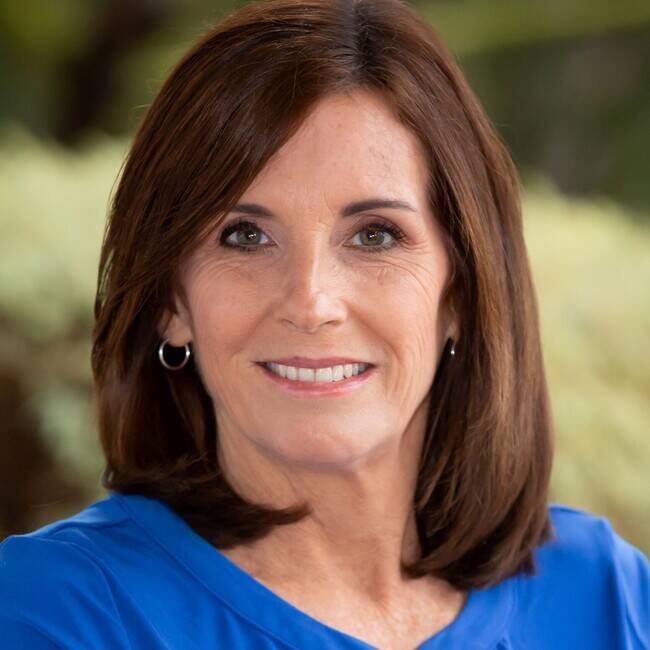
Transcript for Martha McSally Interview on the Beyond Speaking Podcast
In this in-depth interview, Martha McSally, the first American woman to command a fighter squadron in combat, shares her remarkable journey from aspiring pilot to U.S. Senator. McSally opens up about the personal challenges she faced, her relentless pursuit of breaking gender barriers, and the lessons she learned about courage, resilience, and leadership. She discusses how these experiences shaped her roles in military, corporate, and political arenas, offering insights into what it takes to lead with heart under pressure. A must-watch for anyone looking for inspiration in leadership and resilience!
Podcast Episode · Beyond Speaking · Nov 12, 2024 · 27m
Martha: If you're walking into a room as a leader and you actually are fearful, but you're telling your team like everything's gonna be okay, they can sense your energy no matter what comes out of your mouth. And so it's important for you to be aware of what you're projecting with your behaviors and with what you're reacting to and and what kind of vision that you're sharing. And so, I mean, I learned this in my journey to being a commander and leading men and women in combat with high-stakes missions where, if we do make a mistake, lives are truly at stake.
Intro: Welcome to the Beyond Speaking podcast from Premiere Speakers Bureau, featuring in-depth conversations with the world's most in-demand keynote speakers.
Brain: Hi I'm Brian Lord. This is the Beyond Speaking Podcast. Our guest today is Martha McSally, who has a ton of titles, but she likes to go by Martha. She's the first American woman to command a fighter squadron in combat. She's a renowned trailblazer, a values-driven leader who understands courage, adversity, resilience, and the keys to soaring above challenges. She's somebody we've worked with for a long time. So, Martha, thank you so much for coming on and being part of the Beyond Speaking Podcast.
Martha: Hey, absolutely, Brian. I'm looking forward to our conversation today. And hello to everybody out there.
Brain: Yeah, awesome. Well, hey, so one of the things I think is fascinating. Like we've all watched the movies, you know, Top Gun, everything else. When did you decide I'm gonna be a fighter pilot? When did that cut was that like two year old Martha just saw a plane in the sky? Or how did you get to that point?
Martha: That is so not my story. That is the story of many kids, right? Looking up to the sky, going to air shows, you know, little spoons with airplanes on them when they were toddlers. But for me, it was very different. I was a shy, motion sick girl. And I couldn't even imagine my first, you know, I was throwing up on my first, you know, flight that I ever took on a commercial airline. So the fact that my journey brought me to flying fighter jets and paving the way is kind of hilarious.
But I grew up in a middle class family, the youngest of five kids. And I was just blessed to be in a very stable environment, told I could be anything I want to be. But my dad passed away very suddenly when I was 12. And it just was the first inflection point of my life, deeply impactful as anybody could imagine if you have 12 year olds out there. And I went from like my just world just being rocked. And before my dad passed, among other things, he told me to make him proud.
And so I went on this path of being driven to make them proud, but also, you know, dealing with the grief. And I don't, I didn't really know what I was doing. You know, we make these decisions when we're 17, if anyone has teenagers. But I was looking for a way to get a good education, not saddle my mom or myself with debt to kind of protect my feistiness in a way, gave me some guardrails, you know, to keep challenges, good challenges in my way and pay back the country and service.
So I went to the Air Force Academy, but I didn't really know what I was getting into. And I didn't want to be a pilot. I wanted to be a doctor. And when I got there, I found out for the first time in my life that just because I was a girl, I couldn't do something. It was against the law for women to be fighter pilots. And I hope your audience doesn't mind me using this language, but it pissed me off. And I just, it ignited something inside me. It was like, what do you mean I can't do that just because I'm a girl? And I decided, like, well, that's exactly what I'm going to do.
And I just declared, you know, I'm a fighter pilot, I'm gonna be a fighter pilot. And people laughed at me. They were like, Martha, it's against the law. I'm like, yeah, I know we live in America, laws change. And I just kept this dream in my heart and kept persevering and blooming where I was planted without a chip on my shoulder. And it was almost 10 years later that the law changed, the policy changed, and I was in the right place at the right time, with the right qualifications, the right dream, the right grit that I would not let die.
And that gave me the opportunity to pave the way. So it's a crazy story, honestly, of that journey, a lot of you know, challenges along the way. But I kept that vision that that is what I'm going to be. And that's, you know, I mean, that's for anybody. Whether you're as a team, as a company, you've got this vision of 10x or as a person, like where you want to be, like holding that vision and persevering against all odds and keeping, you know, making good decisions to just move yourself through those obstacles and turn them into opportunities. Like that's the way for anybody.
Brian: So was there ever a time that you thought you were going to quit? And if so, why didn't you?
Martha: Many times, Brian. Like many times in that 10 years. It's not some sort of, you know, Hollywood story, right? There were days when I was flying T37s as an instructor pilot in Del Rio, Texas. Nothing against Del Rio, Texas, but I picked this job, you know, in this little town on the border. Like I picked it. It was, you know, I graduated very high in my class and people are like, why would somebody pick a job like that? But I was keeping my options open to make sure that I could still be given that opportunity.
And there were so many days I was like, what was I thinking? You know, where it just looked like it wasn't going to happen. And so for me, it was a, I mean, I learned some tools that I now share, you know, in my coaching and in my speeches, but I share like, okay, you've got it what you do every day sometimes feels like it's not making a difference. But if you just make like a one degree change, right? Like one degree in the right direction when you're flying. If you're one degree off a different course in 60 miles, you're a mile away from the destination. So just little changes over time that you can do as a team and as a person, and you're consistent with them actually can have some big results.
So I had to find myself daily in the mundane, just finding that internal force to sometimes I'm like getting on my knees, like, how am I gonna get through this day? I don't see how I'm going to get to this vision, but I believed in it and I kept declaring it. And then what action can I take today to persevere through? I mean, doesn't mean every day felt great, but I just kept holding that vision.
And it also looked, there were times where I really felt like quitting, but there were wingmen in my life, you know, we never fly solo that I looked to to kind of help give me perspective to help me, you know, continue to persevere. So that wingman mentality of finding mentors, finding people, you know, success leaves clues, finding people who have paved the way before you so that you can continue to see your vision towards the future. And it feels nearly impossible, but not impossible. And it feels realistic.
And for any company out there, any team out there, we're dealing with such challenging times right now. And I know there's times you're like, man, you know, is this turbulence going to end? You know, how are we going to get to where we need to be with all the disruptions and everything that's happening? You know, whether it's technology or labor force, supply chain, geopolitical stuff, being able to hold on to that vision and show the courage for you and your team about how we're going to get there, it's amazing what a group of people can do with just those attributes.
Brian: Absolutely. So I love what you said. Success leaves clues. So who did you learn that from? And what are some of those clues that you picked up from successful people in your journey?
Martha: Well, you know, I think about along the way, most of my mentors were actually men because I was the first, you know, going forward into where no women had gone before. And so I just appreciated, I don't think we need to mentor same gender. Although I will say there were three World War II female pilots who were amazing friends and mentors to me just to give me perspective at times when I was feeling like I was in a dark place, right? Where I was like, man, they were living vicariously through me.
So being able to see like others who have achieved big dreams and whether you know them personally, study them, you know, read their books, listen to them. There's such wisdom packed into what others leave behind. And so having that growth mindset to continue to see somebody else has been through something like this before. How do we use some of these tools and persevere?
I think for me along the way too, it was also, and I see this as you know, as a leader, I talk a lot about courageous leadership. What does that mean? It's not just being strong, right? It's not just being like, okay, you know, we're following the leader because people need heart as well.
And so, like, Braveheart is like my favorite movie, it's my favorite just sort of attribute of what it means to truly be a leader who's doing something really important and purposeful, but also connecting with the people they're leading at a at a heart level, being open, being authentic, being vulnerable, which is not easy for many leaders to do. But finding that balance of how you lead with strength and lead with heart, I just had examples around me and I was developing my own skills, how to, you know, manage my own internal state, make sure I was aware of what was holding me back, right? What was triggering me, what was causing me to be afraid as a leader.
I know I'm jumping into some leadership lessons versus my own journey, but like it's important to have that awareness of like if you're walking into a room as a leader and you actually are fearful, but you're telling your team like everything's gonna be okay, they can sense your energy no matter what comes out of your mouth. And so it's important for you to be aware of what you're projecting with your behaviors and with what you're reacting to and and what kind of vision that you're sharing.
And so, I mean, I learned this in my journey to being a commander and leading men and women in combat with high-stakes missions where if we do make a mistake, lives are truly at stake. And so translating that into business, and you know, I'm on the board of directors of three companies right now. So translating that to coaching executives and CEOs and others about like, okay, how do you take what I learn in the cockpit, when I learn in combat, and turn it into actionable steps, right, for others to be able to use with their teams.
It’s truly important for your audiences to be able to succeed. It's not about you. You know, when you're talking, as you know, some speakers like it's all of it, it's about them. They're telling amazing, inspiring stories. And maybe the audience can be inspired, but I don't want them to be inspired about me. I want them to be inspired about themselves. So I may tell a little story, but you may never fly a fighter jet. That's not the point. The point is what I learned in order to perform under high stakes and lead under high stakes, and that can now translate for you and your team with education and actionable tools for you to use as soon as you leave the room for you to level up for your own top gun team.
Brian: Absolutely. So I'm curious to know what it's like. Do you remember what was like that first time you're going into combat, leading into combat?
Martha: Yeah. Well, yeah, the first time my first sorting, and I didn't know at the time women in the Air Force had ever done this before. I was just trying to fly my jet, right? Make sure I was doing what I, you know, what I was trained to do. This is no longer back in America at the range. This is real life. If something goes wrong today and I have to eject, I could be evading and possibly be captured and be a POW. Like this is real high stakes.
And so I mean, it's the things that we trained at though in training kick in. When you go into the real combat mission, it kicks in because we train over and over and over again in very complex circumstances and we debrief with such intensity where it's like, this is where we messed up today. This is where we can get better. So when you finally cry, I remember crossing over into Iraq and seeing the berm below, the border below, and going like, right. This is not practice anymore. This is real.
But I had to just state it like, what's my checklist? What's my situation awareness? What tasks do I need to do? What's happening in front of me? How are we going to respond and react to it? And you realize, even though it can feel unnerving, like I had to learn how to manage my fear, to hold it. It's not about not being afraid, right? To have it inside you, but then to kind of turn it into jet fuel to have you perform at a high level.
I mean, I always say, it's, you know, courage is not the absence of fear. It's choosing to do things afraid in the midst of the fear. And I think sometimes people think those of us who served in the military, like we're just cut from a different cloth and we're not afraid. It's just not true. Like I felt like I was gonna throw up the first time I took off of the A-10 or the first time I flew in combat or the first time I had a very complex circumstance in combat where I was like, you know, am I gonna save these guys' lives or am I not? But I had to just hold it and turn it into jet fuel for it to propel me. Like what I need to do right now to perform, step out in the midst of that fear and you build your courage and your confidence.
And it's the same thing in life. I'll tell you a quick story if I can. I know we don't have a lot of time, but one of my most complex missions, every mission was different. For those who are watching the video, I've got the A10 behind me. What I flew was a single seat plane. And our job is to do what's called close air support.
So we show up when Americans are on the ground, often in a fire, they're in a firefight. They're in complex circumstances. They're very close to the enemy. They're on the move. And if we make a mistake, Brian, we could potentially kill Americans. I mean, it's really important to understand what's happening, to have situational awareness, to communicate clearly, and then to act with precision in these environments.
And we would take off in Afghanistan with maps of the whole country. And on any given day, we'd be on a routine combat mission, but they would sometimes be like, These guys need you more right now. They're in a firefight. Americans could have already been killed or injured. And they're like, just give us a call sign, a radio frequency and a grid coordinate and say, Go help these guys.
So one day I was a squadron commander at this point. We're taking off. My wingman, we never fly solo. My wingman was a highly experienced pilot, but had never flown in combat before and never flown in Afghanistan before. So his situation awareness is a little low. He's trying to kind of figure out what's going on. I'm the flight lead, I'm the commander, I'm responsible for you know all of this. So we get diverted because some Navy special operation troops had been on a routine reconnaissance mission in the south of Afghanistan and they got ambushed. So they're in this winding canyon.
They're now in firefights. They're low on water, low on ammo, and they're calling for help. And we diverted two of the A-10s in my squadron who were close to help them, but they were running out of fuel. So we scramble to get airborne to go help these guys. And we've got all this amazing technology to be able to operate with precision. But when we show up, the controller I'm talking to on the ground, think about it, he's under fire. He pulls out a pocket mirror from his pocket and he shines the sun into my eyes and says, here's where I am, don't hit me. And I mean, again, these are good lessons in life and business. Sometimes we got all the great technology, sometimes the simplest tools work, right? Just communicate clearly, get the job done.
And so as I mapped out where everybody was, like, man, the friendlies and the enemy were so close. It was very challenging because the direction that we fly in on, you know, what really matters here at the A-10, you know, where our firepower goes, where you could, if you're shooting the gun or dropping a bomb or missile, like the the impact could hurt the friendlies with a little bit of lack of pre, you know. I mean, just if things are off a little bit, which they are in combat, not everything is perfect. So it's always about making corrections.
So I came in for a pass and I shot a rocket where some white smoke comes up to just make sure we're all looking at the same place. Is this the target you want me to hit? And the controller said, Come closer to me, which was just unnerving. And as I pulled off from that pass, my entire heads-up display, which if you've seen Top Gun, you know, where we look through a heads-up display, it shows us airspeed, altitude, dive angle. It actually calculates where, you know, the bombs or the guns are gonna hit. It really helps us if the whole thing fails, Brian. Like the whole thing.
So we've got four levels of degradation, and all four levels had failed. And now I'm back to basically World War II bombing physics where I need to be in a precise airspeed altitude dive angle in order to deliver with precision. But if I make a mistake, I could hurt the friendlies. And so I had to make a decision in the moment: are we gonna just say, no, no, no, we're not doing this, or send my wingman in and hope he was paying attention or bring some other A-10s over while we keep these guys at risk. And I just had to decide, nope, I know how to do this. I've trained at the range over and over and over again in this degraded mode.
I needed to just kind of hold my fear. I needed to do what I was trained to do, come back around, look at my knee board, the calculations, the differences. And I needed to just three to five seconds going down final, had to make sure that I was making corrections to deliver with precision. And I just had to keep the fear inside me. And I had to do what I was trained to do and deliver those weapons to save Americans' lives.
And as I pulled off from that pass, I just waited for the radio call by the controller because if I had harmed him, obviously he's not coming on the radio. And it felt like an eternity. And I waited. And eventually Jaguar 14 came on and said, Good hits, good hits, come in, number one. You got the target's like, So I know what I'm talking about when it comes to operating under pressure.
I just give that little example to you and you know, share what that means, you know, for you in life and business. There's a lot of people who talk about, you know, being a badass and doing hard things who maybe haven't, you know, done things like that. So I say that with humility, like, you know, leading with courage, leading with heart is something that I have learned to do and what I have, you know, shown to do in the experiences I've had in life.
Brian: So obviously it's very different walking into a war room or in a sort of a war zone as opposed to a boardroom. I know you're on the board of directors of three companies. What was that transition like? And what's the I don't know if nervousness is the right thing just because there's so many different things, but when you're walking into that, you're expected to deliver there as well. What's the difference like from a military standpoint to a business standpoint?
Martha: Yeah, you know, I'm in Martha 3.0 right now is the way I describe it. And I mean, what certainly I think one of my superpowers is reinventing myself and having a growth mindset, having a learner's mind, not showing up with ego, pretending you, you know, I know everything, but knowing that I bring you know, capabilities and experience to the table that now needs to be transitioned.
And so, you know, the three companies, I'm on three private companies' boards. I was on a previous one where we exited to Honeywell. I represented Blackstone on that board. I want to say over about three billion dollars in valuation of, you know, of these various companies, all with unique challenges. And I do a lot of executive coaching of CEOs and the management teams in this process. But I found the same tools I use in the military work.
When you first show up, don't act like you know everything, right? Have an open mind and be voraciously learning. All right. What's happening in this company? What's happening in this industry, this market? What are their challenges? What are their pain points? Their opportunities, their successes? What's their zone of genius and their superpower? What could they do, maybe 80-20, right? Where they're scattered too widely and maybe need to hone in on what their genius is and try to 10x on that. So listening, learning, it's the same thing I did when I was a colonel coming into a new job.
Don't pretend you know everything, right? Be listening to those who are doing the work, listening to what's happening out there. And then bring, you know, do your study, do your homework, do your research, and then bring your unique ask good questions too, right? Like curiosity of asking questions instead of just barking out answers or showing how smart you, you know, people might think you are. I just like up past all that.
You know, I'm fairly new on a board and my first board meeting, a new company. I'm like a couple months into it. It's like, all right, I'm just gonna listen. I'm gonna study. I'm gonna spend time with some of the other management to better understand how can I help you? What are your challenges? So that I actually bring value. And it's very easy to translate my life and military and government experiences into because we're talking about humans, humans who are trying to perform as a team at a high level to do something impactful that brings impact and abundance, you know, to the world and others.
So the human attributes of high performing teams, of high performing people are the same, but you need to make sure it's tailored specifically to the team you're working with and what their real challenges are. So I've really enjoyed the transition and I just take again, a learner's learner's approach to it.
Brian: Yeah. So I love that, you know, sort of learner's approach to it, whether you're a colonel, whether you're on the board of directors. I know I mentioned in the intro that you've had a lot of titles. I know there was at one point where we were booking you to speak, and then you said, Hey, hold on, I need to take a break from speaking. I'm gonna be in the Senate. So you've got colonel, you've got board of directors, you've got senator. Can you maybe talk a little bit about that? And then obviously that gives you some insight, both military, business, and sort of political.
Martha: My gosh. Yeah. Well, it's a crazy story, Brian. I know we've known each other for a while, where I was, I basically went from being a, you know, middle class veteran, trying to make a difference with my life with a heart of service, to yelling at the TV about what's going on in Washington, DC, which a lot of people could probably relate to, to looking at myself in the mirror saying, Well, what are you gonna do about it? You know, and one of my favorite quotes is the Teddy Roosevelt quote about being in the arena. And I've always been one to not just be a bystander, but if I feel compelled, like something's not right, well, don't complain about it.
And so I found myself with a crazy story of how I literally quit my job. I was overseas, came home, and was like, I'm running for Congress. What do I do? Do file paperwork somewhere? And so anyway, eventually prevailed like everything in my life. It took a lot of perseverance, a lot of learning, a lot of adversity. But I went from being this kind of nobody, and I say that nicely, like it didn't like I had any special connections in this arena being elected by the narrowest, narrowest amount of the country to serving in Congress for four two two terms, to then being appointed to John McCain's seat for two years, which was an incredible honor. You think about it. I went from studying him as a cadet at the Air Force Academy to serving in his seat in the US Senate. So, you know, that was about nine years of my life. That's Martha 2.0.
I know that now in Martha 3.0, sometimes with the divisiveness going on, people are like, I don't know. We don't, you know, I wanna just say I joke that it's the least interesting thing I've done in my life being in the US Senate. And if there's any concern about we don't want it to be divisive, trust me. I, you know, if it does come up, I will be funny about it. I will, you know, self-deprecate if it comes up in a Q&A or something, and very kind of unifying in a way of how I share what my experiences were deploying to Washington, DC.
People ask me all the time, like, have you been back to Washington, DC? And I'm like, no, I looked at it like it was a deployment. I literally have not been back. I've not been back to Afghanistan either. Why would I go to either place? Right. So yeah, so I was honored to serve, to make a difference in this slightly you know dysfunctional place, as much of a difference as possible. But you know I thank God every day that it's over and I'm not there.
Brian: Yeah. Well, I think though too, it does give you some unique insight. Again, like a unique speaker of a military speaker who's also got this big background, who also, you know, especially when you're talking to top level leaders who need to know how policy gets made, how things are done. I mean, how does that help you out when you're talking to maybe a group of CEOs or a group of leaders? How does that background in Washington help you help them?
Martha: It really does help because I, you know, have that firsthand experience of what it takes to advocate for something or to make a difference if you're trying to actually, you know, you're in a certain industry. There's some sort of regulation that might be coming down. You're concerned about changes in administration or whatever's going to happen related to taxes and anything that's unique to your industry.
So I do have that inside look about, okay, here's ways to be effective in order to ensure that what you're trying to do is understood by those who are actually in the arena making legislation or regulations related to your industry. So what's effective, what's not effective, is a really important thing for people not to waste their time for senior leaders to make sure that they are getting their voice heard. And that their representatives understand the unique challenges that they have and how say a regulation may impact them. So I can definitely provide that perspective that isn't just from, you know, watching television, which is bad for your health. But that's actually like, all right, if you want that kind of advice, I'll share with you you know, how to be impactful.
And some of the board positions I'm in, of course, you know, some of them are in defense and aerospace. So they were dealing with, you know, government funding and what's gonna happen, you know, is there gonna be a shutdown? I mean, all this crazy stuff in DC. So it does help that I can pick up the phone and be like, hey, what's really happening there? And also get a sense of, you know, the reality of what's moving and how it's moving and where to where to engage and how to engage for the best ROI when it comes to what's going on in that place called the government that impacts our lives.
Brian: That's awesome. Well, Martha, thank you so much for taking the time to be on the Beyond Speaking podcast. For those of you who are watching and listening, make sure to subscribe, rate, and review. You can also check out Martha McSally's information at premierespeakers.com. So Martha, thank you again so much for being a part of the Beyond Speaking Podcast.
Martha: Thanks a Brian. Enjoyed the conversation. All the best.
Outro: Thank you for joining us for the Beyond Speaking podcast. To learn more about today's guests, visit PremiereSpeakers.com. Make sure to subscribe and leave a review wherever you listen.