Transcript for Keith Ferrazzi Interview on the Beyond Speaking Podcast
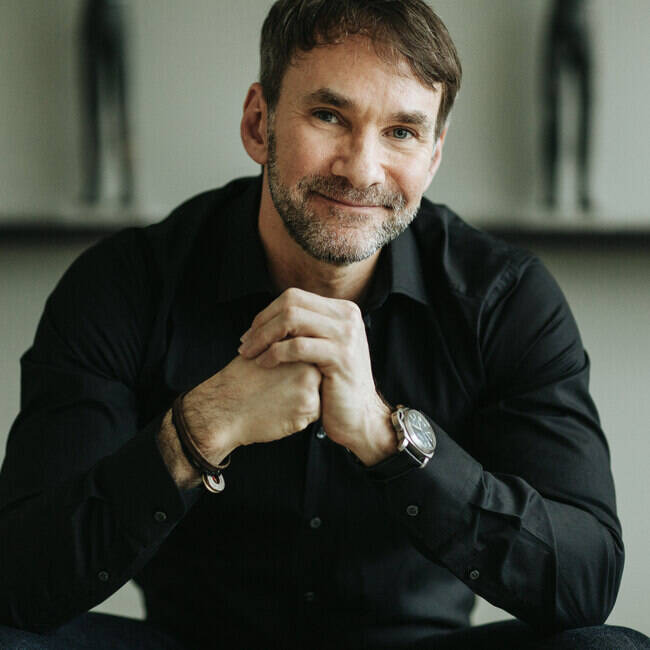
Please enjoy this transcript of Brian Lord’s Beyond Speaking Podcast Interview with Keith Ferrazzi, a renowned executive team coach, keynote speaker, influential thought leader and founder of Ferrazzi Greenlight, where he has spent more than 20 years coaching Fortune 500 companies, unicorn startups, and even governments.
Podcast Episode · Beyond Speaking · Mar 4, 2025 · 27m
Keith: So there's three levels of AI that teams need to grasp. The first level is how do you get your teams to use the tools that they already have to improve their roles? I'll come back to that because that's where most teams are. The next one is how do I rethink the workflow itself with AI as a business partner? So that the role that I have may even shift or disappear, or AI takes over that, but the workflow changes. And then the final is really rethinking business models around AI.
Intro: Welcome to the Beyond Speaking podcast from Premier Speakers Bureau, featuring in-depth conversations with the world's most in-demand keynote speaker.
Brian: Hi, I'm Brian Lord, the host of Beyond Speaking Podcast, president here at Premier Speakers Bureau. I'm excited to have on Keith Ferrazzi. Keith is a number one New York Times bestselling author of books like Never Eat Alone, Leading Without Authority, and including his newest book, Never Lead Alone. Keith previously served as the chief marketing officer of Deloitte and Starwood Hotels. Today he's recognized as one of the world's top executive team coaches. And his clients include the turnaround of General Motors and the country of Bhutan. And Keith is also a venture partner at Lightspeed, where he coaches some of the fastest growing unicorn executive team. So, Keith, thank you so much for joining us and being a part of the Beyond Speaking podcast.
Keith: Brian, thanks a lot. That was a great introduction. I don't know if my team passed that onto you but it was great.
Brian: They did. I can't, it's Caitlin. You can that's Caitlin's intro. I threw in a little bit, but that's ninety nine percent Caitlin's.
Keith: Right down the middle of the alley. Fantastic. Thanks. We've got it.
Brian: We got it. So we're gonna talk a lot about a lot of things, like leadership, teamship, AI, how that all filters in. But the first one, like in your intro there, you helped with the turnaround of the country of Bhutan. So it's not often that somebody goes in, like one person goes in. So I'm sure our audience is thinking, well, of course you have William of Orange in the late 1600s who went from the Dutch Republic and helped turnaround England. And so you've got Keith here. I was gonna say Keith of Orange, you're probably more Keith of black and yellow since you're from Pittsburgh where everything's every team is black and yellow. So Keith of Black and Yellow, how I know you get your terrible towel out going around there. Our producer, Eric's gonna love this because he is a Pittsburgh Steelers guy. Anyway, so how does somebody go in and turn around a country?
Keith: Well, first of all, with a lot of humility, it all started when the King of Bhutan was doing a tour of the United States, talking about his country, enlisting the support of others. This is one of the most humble, curious, thoughtful, and compelling humans I've ever met. Just an extraordinary, extraordinary man. It's a Buddhist-based country, and so the humility and the grace is extraordinary as well.
When he and I were chatting over dinner with a group of executives, yeah, as you well know, I'm the guy that wrote the book Never Eat Alone, so I don't. You know, people that come through the area of San Francisco will also reach out and try to get dinner parties and things thrown together of some interesting folks. And so we put a really cool group of folks together. And I always show up, no matter what, when I meet somebody, no matter who they are, I just show up with what I always call five packets of generosity. I asked myself in advance, how can I be of service to this person? What are five things I can do? So I'm researching, et cetera. And I realized a couple of things. His vision was to double the GDP of the country, but still to sustain the pristine nature. You know, they measure gross domestic happiness. Isn't that the coolest thing? They measure the happiness of the country.
And so I was suggesting on the winning side, on doubling the GDP. I was suggesting a number of potential partnerships, connections, et cetera, that he could make. And then I was thinking about the humility of the organization. When I think say the organization, what I learned is, you know, a government is nothing more than an organization where you have ministers, secretaries, you have private sector, you've got the royal in this case. All of those need to work more effectively interdependently as a team.
And they need to do what I call “co-elevate.” They need to have a shared mission, but they also need to work together and push each other higher, challenge each other's assumptions. I don't know if that sounds interesting, but that's exactly what every team needs to do, right? In an organization, whether it's a nonprofit or otherwise. We've worked with the World Bank using this same principle as we do with General Motors or a company like Google. So when I was teasing all of this out as I was leaving, His Majesty said to me, hey, do you do WhatsApp? I'm like, Well, I kind of don't, but for you, I think I'll I'll I'll do WhatsApp. So he takes my phone, puts his number in, but he just put his number in. And so he was as he was walking away, I'm saying, I said, I'm sorry, what do I call you? And he goes, my friends call me HM, his majesty. So his majesty and I were texting WhatsApp for a few weeks, and then he invited me over to the country for their national day. And I just fell in love with one of the most beautiful countries in the world.
And we now have over twenty coaches volunteering time through our foundation in all of the ministries and then working to stitch together a high performing team that will allow the mission to achieve. So that's the history. Maybe a little longer than you expected. Sorry.
Brian: No, all how long ago was this? Or like when did it start?
Keith: Two years ago. Two to three years ago. And the country has made amazing strides as a team, as a country. The intention and we've just had a major forum where they brought Nobel Prize winning laureates from all over the world. So the idea of teaming out and inviting with humility individuals in to co-create an extraordinary future.vFor the country, for individuals, it's been quite a blessing.
Brian: Wow, that's amazing to kind of be there at that kind of level, like a nationwide level within that and being part of it. How much of that played into, I'm trying to remember the date when, when Never Lead A Load came out, how much, how much of those things played into it?
Keith: Well, I was happy that the Prime Minister gave a jacket cover for the book because you know he was absolutely committed to those principles. You know, this book, Never Lead Alone, has been a book that I'd been working on for 20 years. And the reason it's so short is because I've had 20 years to perfect it. That old Ben Franklin quote, you know, excuse me, this letter is so long, if it was if I had it wouldn't have been shorter if I had less if I had more time.
The idea of the book is we need to begin to shift from leadership to teamship. And it's one thing for a leader to give great feedback. It's another thing to get the team to give each other feedback. It's one thing for the leader to hold the team accountable. It's another thing for the leader to get the team to hold each other accountable, for the team to own and celebrate each other and to celebrate each other's energy and lift each other up. The team itself needs to step up and we should expect more from teams.
And this has been an extraordinary topic for leadership off sites, for organizations, because it's a dimension that many organizations really just haven't considered. And then what we do, and because it's 24 years of research, it's so practical that each chapter of the book has a hero's story of an individual that's just crushed it in that shift, like from conflict avoidance to candor, from accidental serendipitous relationships to purposeful bonding, from individual accountability to team accountability. So every shift has a hero story. And then we just give some very simple practices that I can talk about in a speech that I can, you know, we coach to in organizations that are really game changing. The book has done so well. It's one of the books I I've written five books, and the only other book that keeps showing up on bestseller lists way after the launch was Never Eat Alone. And then twenty years later now never, Never Lead Alone.
Brian: Yeah. That's awesome. I'm curious. So one of the big terms that you use in there is teamship. So what's the difference between leadership and teamship?
Keith: Yeah, as I was saying, I feel that our research has shown that the highest performing teams are ones that look to each other before they look up to the leader. And they expect more from each other than the average team. The average team sees the team as a group that your work plugs into. Teamship is a team where they see that we're going to cross the finish line together.
Where we only win when we all win. When my work will be better by showing up and asking the team to stress test the most critical threads of our work. You know, they challenge each other. Some teams believe that you would never challenge a peer, that would be throwing them under the bus. Other teams believe we're gonna challenge each other openly in the room, even when it's risky, because we refuse to let each other fail.
There's a wonderful story of a company called Elf Beauty. Now, this is an organization that has been absolutely crushing it. Multi-billion dollar company, publicly traded business, taking market share from the big, the biggest of the beauty companies in the world. And they have a social contract. I talk about culture as a social contract among people. They have a social contract that says for the next three years, you're going to grow further and faster than you ever have in your life when you're here at ELF when you join the company. But your agreement is you will receive feedback with elegance and grace because we care about you. We love you. We want you to be successful. You don't have to take the feedback, you don't have to use it, but you have to take it. And alternatively, you also have to give that kind of fluid feedback because you can't let anybody fail. We've got to make sure that we support each other and that word co-elevate, constantly pushing each other higher.
So that's basically the essence of teamship. And it's been a real runaway success.
Brian: Yeah. That's great to see just kind of thinking of it in a little bit different way. it kind of getting into the nitty-gritty. What is a good way? I know you're talking about taking things with grace and that sort of thing. What's the right way and wrong way to have accountability?
Keith: Yeah. Well I'll just give you one of the practices. It's called stress testing. So many organizations do report outs in their meetings. And so you show up at a meeting and in that meeting someone's giving a report out of an initiative that they're working on. And, you know, unfortunately sometimes it's 20 slides clicking through, whatever. By the time you get to the end of it, the leader has some comments, maybe one other person does, and then we move on to the next one.
If on the other hand that person was showing up and they knew we were going to do stress testing of this initiative, they would show up. Everybody would be attentive because of what happens after the person reports out. The person would report out what they've achieved. It would be mandatory that the person reports where they're struggling and then where they're going in the next sprint of work that they're doing. And then everybody in the room goes into small conversations of two or three. When you have a big room of people and 12 people, four people will think they're hurt. When you go into small conversations, it increases the psychological safety by 85%. And 10 people think that they're hurt.
So the simple practice of going into small conversation about what was just heard, but then what we do is we assign what they talk about. They have to fill out in a Google Doc or a Microsoft document three simple questions. What challenges or risks might this person not see? What innovations or ideas could benefit them? Where might we be helpful? And then they write all that up and they hand it back to the person in electronic format, and you can do a report out to talk about it. But what's just happened is you've turned to the kind of culture you wish you had, a supportive culture where people are helpful, a curious and growth culture where people are offering ideas, a challenge culture where people are pointing out things that they see. You've just turned that into a simple assignment.
So the simple act of stress testing, it's an article I wrote recently in Fortune magazine. The simple act of stress testing is game-changing, game changing for a team. Simple practices. So the book is 10 shifts from leadership to teamship. Every chapter has a hero story, a couple of pages of somebody who's crushed it in that particular shift from conflict avoidance to candor. Then three or four practices that they can use, which you know, I probably use five or six different practices, you know, in a keynote talk where people are like, my God, this was not only eye awakening, but it was so practical. And thank you very much. I can't wait to use those. And I will do workshops too, where yesterday I did two and a half hours, where it was a little TED talkie keynote. Then we go to the tables and they talk about the practices and they start applying them, and then they go back to a keynote back and forth, which I love, I love doing those things as well.
So that principle of the book is so practical, step by step, chapter by chapter. Hero story, practices. We even put a diagnostic tool in the book where somebody were like, where are we right now on the spectrum?
Brian: So I like how you diagnose. well actually first before we get to diagnosis. So we talked about accountability. What are out of those 10 shifts, obviously not all 10, maybe what are two or maybe maybe two of them that are the most in demand when you're talking to somebody ahead of time, they're like, This is what we really need. And you're like, okay, I'm gonna talk about this one of these two.
Keith: Two of them. Well, I'll give you three. One breaking down silos. So chapter one talks about redefining the team having nothing to do with an org chart, but focusing predominantly on how we get work done and cutting down silos, getting people out of their ruts. And and and it really it's a it's a it's a it's an awakening of change management. How do we get the most important people involved in the team early? Not doing buy-in where you've collaborated now you're trying to convince other people and what you're doing. So, that practice is called building a rap, a relationship action plan, where each team reconfigures who is the core team and who is the matrixed team. And then how do we stress test with that group of individuals so that they're coming along the journey, right? So I would say breaking down the silos, working in a matrix, leading without the authority to lead these individuals. So that's one.
The other one is always the movement from conflict avoidance to courage and courageous dialogues. And that uses the kind of practices like stress testing we just talked about a second ago. It used things called candor breaks, really simple times when during a meeting you stop and say, What's not being said in this room that should be said? And if you did it in a room of 12 people, you'd get crickets. But if you go into groups of three, have everybody talk about it, what's not being said that should be said, and then start again. It's game changing. Right?
And then I guess the third would be on the resilience mental health side of things. How do you move from a team thinking that resilience was their individual responsibility to thinking that we've got each other's back? We are holding each other's energy clear. There's a wonderful simple test practice called an energy check. Once a month, a team goes around and says on a scale of zero to five, here's where my energy has been lately.
And why? And what we find is that, by the way, on a metrics perspective, the average team from a candor perspective is usually a 2.4. When you do the stress testing and the candor breaks on regular intervals, in six months, you can get the candor of a team on a scale of zero to five to three point nine, and then into the fours within a year. So we could gain these simple high return practices that are game changing.
On the principle of resilience, does my team have my back? Right? Is my team keeping my energy strong? The average team is in the high ones because we don't think of it. We think it's my job to keep my energy strong. If I hit a wall, I've got HR and my boss. But now we're saying the team's job is to keep each other's energy strong. And we can move in six months into the threes again with simple practices.
I would say those might be the three. Although I'm tempted to dive in to do a bunch more, but you know, it's funny because I always do a diagnostic set of interviews. I'm very generous with my time. When someone's paying for me to come in and they're they're they're they're trusting me with their team. I want to make sure that we crush it.
I want to make sure that none of my talks are pre-canned. They're all like, tell me what your issues are. I call my talks challenge talks. I like to really understand what the business issues are of the team, what the engagement, leading engagement issues are with the company, what the future strategy is, what's the velocity of change going on here? I understand all of that. I mean, I've been in this business for quite a long time, coaching and consulting transformation of teams. And once I understand that, then I put together a really powerful challenge talk for the audience that is both, you know, very practical, inspirational, funny, uplifting, but ultimately lands the plane in what the executives are trying to achieve.
Brian: That's great. And I you know, the customization you do goes beyond just sort of you know, the traditional things of leadership and teamwork. You're actually doing a lot in terms of AI. Like how do these new teams develop into that? Can you touch on some of those things that you're doing right now and groups you're working with and how that plays into how companies can be more successful?
Keith: Yeah, for 20 years, my focus has been high-performing teams. So we did a five-year study in 2010 on what are the new people rules in a virtual and hybrid world when nobody else was looking at that question. From 2010, 2005, we published 18 pieces in Harvard Business Review. So when 2020 came along and everybody all of a sudden was virtual and hybrid, we had all of the best practices around how to lead hybrid teams more effectively.
Now, today, I have been a part of Peter Diamondis's advisory board. Peter wrote the book Abundance, The Future is Faster Than You Think, the ability to bring all of these futuristic ideas into today's principles. I've been working with Peter for years. I've been studying AI since 2017. and so we have been looking at How do you crowdsource among teams critical use of generative AI to transform our basic workflows?
So there's three levels of AI that teams need to grasp. The first level is how do you get your teams to use the tools that they already have to improve their roles? I'll come back to that because that's where most teams are. The next one is how do I rethink the workflow itself with AI as a business partner? so that the role that I have may even shift or disappear, or AI takes over that, but the workflow changes. And then the final is really rethinking business models around AI, which is mostly for a very premier executive team to think about.
But let's go back to the basics: how do we use tools? I'll go into an organization like yesterday. We had a very well-known large company doing the leadership offsite of the top 200 people in the company. And I asked each of the leaders, pick one role that you think could be augmented with AI. And the very simple answer would be: ask everybody in that role who's currently using some AI tools, and ask anybody in that role who would like to be more aggressive over the next three weeks and figure out how AI could reinvent their role. And then you invite a hand raiser.
So let's say you have a hundred people in that role. Let's say you get 15 people offering to do something. Ask them to write up what they're currently doing. Now, usually from that 15, it goes down to five that's actually doing anything worthwhile. So those five individuals, put them into a small team for three-week sprint and at the and have them meet once a week and coach each other on their tool use and what they're doing, and tell them at the end of three weeks, they're going to present to everybody in that role how they're currently reinventing their role with AI and what the highest return practices are. Such a simple model of crowdsourcing the insights from the individual. And people love that. I mean, we had everybody in the room figuring out which role, how they were going to do it, kicking that thing off. I promise you, within two months, they'll be one of the best practices in the use of AI in their industry segment.
Brian: Yeah. And that is one of those things, like, what are you most excited about? So obviously you've got this practice, the application. What are you most excited about in this realm in terms of the use of AI?
Keith: I'm actually most excited about the reinvention of workflows themselves. But I'm also very interested in something really simple. So, in one regard, you take a look at the supply chain. We're working with one company that's in the process of reengineering three trillion dollars of supply chain. Absolutely crazy. And they will be able to take a 20% cut out of that. And with rethinking the workflows of the supply chain. Fundamentally meaningful.
But on the other end of the extreme, I'm excited about reinventing scheduling for the company. Imagine if you needed to put a set of meetings together and the AI could, in the snap of a finger, find the perfect time for all of the right people to be in that meeting and get it scheduled. So there's some really practical, simple approaches to things.
And by the way, don't get me started on meetings. One of the things I bring with my work is that work back in 2010 that I did about hybrid and virtual teams? I believe fundamentally that most organizations have radically overindexed on meetings. And when I work with a team, we reduce meetings by 30%. I did a really cool TED talk for the Forbes conference Future of Work, where I talked about meeting shifting. If you have a meeting of 12 people, I mentioned earlier, four people think they're heard.
But what if the topic starts to collaborate? Not just editing documents, I have some more clear practices. What if the conversation starts before the meeting? And people are saying, here's the real problem we're trying to solve, here's a bold solution, and we're wrestling ideas in the cloud before we show up. And then we show up and we don't even need all 12 people. We need four people to land the plane on a bolder solution than we ever had. That's called meeting shifting. And me talking to leadership teams about meeting shifting. They love that. They love that.
Brian: Great. So I've got one last question here. And I always like the origin type stories of things. So my wife's grandfather was born in Italy, a very Italian family, everything else. Your parents came over from Italy. I know your dad did at least I think you're I think you said your mom did as well.
Keith: Mom's American English.
Brian: America, okay. Very so coming over from that, what do you think that that played into both in like never eat alone? Because I know Italians are at least the ones I know, pretty social people. And then how did that factor into what you write about and also your drive, your success drive?
Keith: Very kind of you. You know, one of the things that I clearly love to do with audiences is really tether emotionally to them. And my origin story is very important to me. Thank you. You know, my dad's family came over from Italy, and there was hope of prosperity and aspiration of the American dream. But unfortunately, they landed in Pittsburgh, Pennsylvania before the steel crash of the 70s. Unemployment. My dad was unemployed. My mom became a cleaning lady. It was a tough way. And from a very early age, I had committed that I would grow up one day and fix American manufacturing because of the destitute nature of the city and in our family all as well.
When and when our work actually was credited with a part of the turnaround of the General Motors organization and the bringing together of that team coming out of bankruptcy and making sure they paid off the TARP money and moved forward as a fully forming, high functioning team. By the way, Mary Barr is one of the great leaders on our planet. She's extraordinary. It brought tears to my eyes. You know, the culmination of all of that aspiration and work to be able to bring a critical shift of rethinking how work is done. How teams function. You know, back in the day, it was total quality management engineered by manufacturing engineers. It was agile, engineered by software engineers.
And we're at an inflection point today where we need to re-engineer the way work, the world works and how work works. And we are desperate for the engineers to rethink work. And unfortunately, we're approaching it with policy. How many days of work should we be in the office? When we really need to be rethinking the fundamentals of work, including how to get more from our high performing teams and that shift from leadership to teamship.
Brian: Mm-hmm. Well, Keith, thank you so much for joining us here on the Beyond Speaking podcast, for sharing your wisdom, your stories. and if you ever get that like Bhutanese knighthood or something, if you become Keith of Black and Yellow, I'm looking forward to that day. I want to get an autographed picture from that. but thanks so much for joining us here on the Beyond Speaking podcast.
Keith: Brian, what a pleasure. What a pleasure. Thank you.
Outro: Thank you for joining us on the Beyond Speaking podcast. To learn more about today's guests, visit PremiereSpeakers.com. Subscribe and leave a review wherever you listen.