Transcript for Chaunte Lowe Interview on the Beyond Speaking Podcast
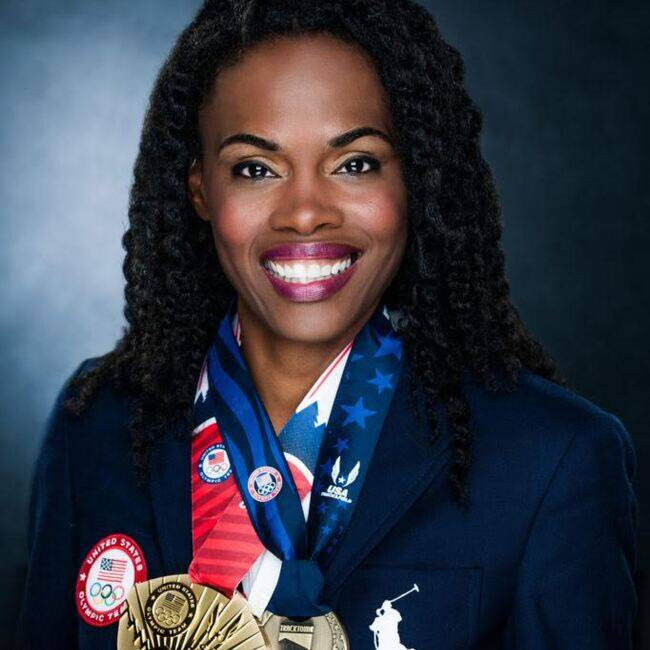
Please enjoy this transcript of Brian Lord’s Beyond Speaking Podcast Interview with Chaunte Lowe, a 4-Time Olympian, U.S. record holder in High Jump, featured in 3 separate hall of fames, world-renouned speaker on resilience, all while being a mother of three.
Podcast Episode · Beyond Speaking · Nov 4, 2025 · 30m
Chaunte Lowe: After I was faced with the cancer diagnosis, I went through my treatment. I had to wear a mask for a year because my immune system was completely, you know, it was completely depleted. And the first place that I wanted to go after I finished chemo to have my celebration was a cruise ship. And so February 29th through March 6, 2020, I had seven days on a cruise. With no mask. It was the best time possible, but then obviously we were hit with COVID.
Intro: Welcome to the Beyond Speaking Podcast from Premiere Speakers Bureau, featuring in-depth conversations with the world's most in-demand keynote speakers.
Brian Lord: Hi, I'm Brian Lord. This is the Beyond Speaking Podcast. Our guest today is Chaunte Lowe. She has an amazing story of determination, perseverance, and strength. Chaunte realized her childhood California dream of going to the Olympics at only 20 years old. She's been to four Olympics. She's a three-time world championship medalist, a 12-time US national champion, and has an amazing personal story as well. A mother of three, a cancer survivor, and somebody who teaches everyone how to dampen out the noise, focus on their goals, and be successful. So Chaunte, thank you so much for joining us and being part of the Beyond Speaking Podcast.
Chaunte Lowe: Hey, thank you. I'm honored to be here. Matter of fact, I'm going to take you with me because that introduction was great.
Brian Lord: Well, I had some help. So anyway, well, I'm excited to have you on. I know, you know, everybody loves the Olympics. It's this amazing dream that so many people have. So few actually get there. When did you get the dream to become an Olympian?
Chaunte Lowe: So I got the bug for the Olympics when I was four. And I think back to the 80s. The whole world stops when the Olympics come on. So I'm watching the Olympics like everybody else. It was my first time seeing it. And then I see Flojo. Like you remember Flojo with the hair and the nails, like a track icon. And so I was not immune to her just alluring power, I guess. And I just wanted to be an Olympian. Right after seeing her, I knew that's what I wanted to do. Now I'm gonna be honest, I also wanted to be a surgeon, I wanted to go to the moon, be an astronaut, and I wanted to be a model, a doctor, and marry Michael Jackson.
Brian Lord: That's a busy afternoon right there.
Chaunte Lowe: Most of those things happened, some of them didn't, you know.
Brian Lord: Yeah. No, that's great. And so what's the gap between? So I already mentioned you became an Olympian at 20. Yeah. You're at four. What kind of happens in between? Like what are some of those formative things on the way to the Olympics?
Chaunte Lowe: Yeah. So immediately I go outside, I'm running, jumping all over the place, you know, trying to imagine what it would be like to be an Olympian. But in that time period of thinking about wanting to do it and actually being able to do it, I had a lot of turmoil going on at home. So we had domestic violence, incarcerated parents, drug abuse in the home, traveling back and forth to homeless shelters, motels. So it's kind of not an environment that's really conducive to trying to become an Olympian, but that hope never died inside of me. So no matter what was going on on the outside, I realized that that dream, that excitement of the Olympics, was actually an anchor of hope forcing me to not give up and causing me to just put one foot in front of the other, live out each day the best that I could, but knowing that ultimately I'm working towards a goal and whatever was going on in my environment, I saw that as temporary, but I saw the goal as the permanent thing.
Brian Lord: Mm-hmm. And I know one thing you talk about is making good decisions. So, sometimes they say, you know–like my parents were divorced and obviously, you had a very difficult situation there with yours–the saying is you either become a reflection or a reaction to your parents. So what were those things, and who kind of stepped in as a mentor? Who helped you learn how to make good decisions?
Chaunte Lowe: Yeah, so I had a really amazing grandmother. I wish that she was still here. Her personality, I would say, is probably where I get a lot of my personality from, but she is a loud, boisterous, fun-loving person. And you know, she had her own goals when she was young of becoming a famous singer. She ended up getting pregnant at the age of 16, but she never allowed that to deter her. And she would volunteer to sing at events like large and small.
She ended up singing at a very small fundraiser in Pastor Robles, California, which most people don't know where that is. I used to be so embarrassed from being from there, and now I'm just so proud of it because it has blossoming wine festivals and a whole culture where people are like, “that's a very highfalutin place to go!” Like, really? That was a country bumpkin, embarrassing place to grow up in.
But she would sing at these fundraisers. And one day she was singing at a very small, uneventful fundraiser, and she made this man cry. Like he's at the front of the stage, crying because of how she sang. And that man was Mr. Ronald Reagan. And he invited my grandmother to sing for him for his inauguration. And so she actually was the person who sang the national anthem. And so when she shared that story with me, she allowed me to understand that your circumstances do not dictate what you could achieve or what type of future you would have. You control what is controllable. She committed to her dream. She didn't care if the event was large or small. She decided that she was going to dedicate her life to excellence. And she realized that you never know who's in the audience. You never know who's going to be that person that could lend you a helping hand or when the opportunity is going to arise, but you always want to be in the position where you qualify yourself, not looking for somebody else to qualify you but the decisions that you've made up to that point to qualify you.
And so, you know, I remember my grandmother seeing me in that situation with homelessness and dealing with a lot of stuff. And she said, “Look, your life right now does not dictate the life that you have to live in the future.” And she was just like putting that control back into my hands. And I've carried that with me my whole life. You know, I went from wanting to give up because we were homeless to now, like, okay, I got this. Every opportunity, I'm going to seize it. And I feel like that's what I give to my audiences. Like, not everybody has to experience those hardships to be able to benefit from them. I was very much the type of person to where I would learn from the people around me. So like if somebody's doing something I do not want to experience in my life, I use that as a roadmap of what to avoid. And then, you know, when you're looking at, you know, mentors or examples of what you want to achieve, I feel like it's very important to align yourself with the processes, mindsets, and practices of somebody who's already achieved it. And you don't have to know them. You don't have to be in proximity with them. You just have to have access to their lessons and information. And that's when I started realizing I could read books because people like to talk about the game plan in the books. I could read books, I could find coaches, I could find other athletes, and I could try to emulate what they're doing because I believe that, you know, insanity is doing the same thing over and over and expecting a different result. But you could utilize that for good too. If somebody's doing something fantastic, amazing out of this world that you want to achieve, then do the same thing they're doing because anything differently is insanity.
Brian Lord: Absolutely. Who are a couple of your favorite mentors you don't know? Putting it that way, whether it's a book or just a story, who are one or two of your favorite mentors that don't know and they are a mentor of yours?
Chaunte Lowe: Michael Jordan. So one thing that I learned early on is like there's a hard you know when the hard practices are coming, especially in track and field. Our sport is everyone else's punishment. So when I read his book when I think it was in middle school potentially, and he was talking about he never missed a practice, he never missed a game, even when he had that flu or food poisoning or whatever it was, he still played. And I started realizing, okay, the accountability of showing up every day. I started emulating that.
And then, you know, it's gonna be a weird one. I don't know. I told you I wanted to be a model at some point. So pre Project Runway or whatever her show was, Tyra Banks. She did a cover, she did a book where she went without makeup. And I know, like as a young girl, being impressionable, she showed that being authentically who you are unapologetically was good. And so, you know, just seeing that example of somebody that was okay being vulnerable, didn't care what other people thought about them, like that empowered me internally. :
And then, you know, you had I've met him, but like not really. Kobe Bryant. And the way that he impressed me is that when all the other NBA players would stay on ships far away from the Olympic Village, Kobe Bryant made it a point to come to the Olympic Village, be with the other athletes, walk around, and get that experience. And it kind of showed me like no matter how big you get, you should never get too big to be a part of the moment. Like he understood that it was a big moment.
And then I started paying attention to the mamba mentality and what it really meant to be a champion. And I just got to meet this person this year, but Michael Phelps. So like now we've done speaking engagements together. And I met him at the Olympics, like taking pictures before the opening ceremonies, but actually having a great conversation with him. It was about his book. And he was talking about how he and his coach strategize to become the best in the world. And I love to, even when I'm talking to my husband, my youngest daughter today said, “hey, can I go to the Olympics?” And he's like, “well, you know, it's really hard.” I was like, “don't tell her that. You got to tell her that, no matter what, if there's a will and there's a process, there's a way. It might not look like everybody else's, but you never give up on that dream. It's okay to use strategy with your goals and dreams and hopes.” And so yeah, those are my four.
Brian Lord: Yeah. No, that's awesome. I love it. Because it's one of those things too. And now I'm like, if you're a high jumper, you can obviously jump. So did you ever play basketball too? If you have all these basketball mentors?
Chaunte Lowe: Okay. I did. I did basketball, tap, jazz, ballet, soccer. I think at a certain point, you're not gonna know what you're good at until you give everything a try. So give yourself, you know, if it's two months, a season, something, give yourself an opportunity to try different things. I found high jump in the most unconventional way possible. It was the early 90s. Do you remember that song by Chris Cross? Do you remember them?
Brian Lord: Yeah, “make you jump jump.”
Chaunte Lowe: Yeah. There you go. So my sister's playing that song super loud, and I'm jumping on the mattress. I get knocked off the mattress, but the music's still good. So I'm jumping and dancing. And I realize I'm jumping head and shoulders over the other kids. And I'm like, my gosh, I have a real talent here. And so I very much believe in, you know, you kind of go with the flow, go with the path of least resistance. And you know, sprinters were short. They were stocky. I'm 5’ 10”. So I wasn't gonna be a gymnast and I wasn't gonna be a sprinter. And I realized that jumping was a true talent. It complimented my body type. I was perfect for the high jump. And so I made that switch. I loved flying. I loved jumping. And so that's how I found it.
Brian Lord: That's great. No, I love it. That's the most accidental way, you should just have kids jump on beds and see whoever gets the air there. That's awesome. That's very cool. I love how that came together.
Now, like in any story, you have some downs and dips and everything else. Part of yours is coming back from difficult sort of situations in more of adult life. I know we talked about a lot of tough stuff when you were younger. What are some of those things in your track career, personal life, where you've had to come back from some difficult things?
Chaunte Lowe: I love that question because I think that that's the true value that I bring to the audiences that I get the opportunity to share with. It's not necessarily the fact that you do fall, it's the matter of what you do when you fall. And, by virtue you see this high jump bar behind me, I didn't know that I was signing up for failure every single day. And what people don't know is that in the high jump, you get three attempts at every single height but you keep going until the bar wins. Every day. So every day, every practice I am facing failure. And what really makes the difference like while you're in the middle of a competition your coach can talk to you, give you some pointers, make some adjustments, but there's not really a lot you can do on the day of. It's what you do after you fail, after the bar has won, that determines if you'll come back and jump higher. And so in that process, every single time after I've competed, I'm like, “man, I should have done this. I should have done that. I could have done this better.” And all of a sudden, I have this wisdom that only comes from hindsight. And I realized that the greatest strides that I was able to make in competition is when I took that information, applied it to the next week of training, applied it to the next session of practice, and then I tried again the next week.
And so that was like on a very, very micro level. Well, when I go to the Olympics, you're training for this for like the first Olympics from the age of four to 20. So like 16 years I've been waiting for this moment. I'm thinking, like, I'm gonna go here. I've earned it. I deserve it. I'm about to make my mark. I got my behind kicked. Like bad. Like it was so bad. There's a preliminary round and a final round. I didn't even make it to the final round. I jumped so low that it was lower than I jumped my first year of high jumping. That's how bad it was. And I'm just like, “what happened?”
And all of a sudden, in the four years, like did you stretch every day? Did you drink your water? Were you strong in the weight room? How many days did you go to the weight room, pretend like you lifted, and then left? You know? And I'm like, “wow, I have ownership to take in this moment.” And I realized that if I wanted to be serious about being a medalist, I could sit there and allow all this hurt and anger and frustration to cause me to quit.
Or I could do that same process I've been doing every day: take the information, take the wisdom, find those mentors, whether they're in person or somebody's book or somebody's information, align myself with something different, reframe my mindset, refine that process and try again. And so I did that for the 2004 to the 2008 Olympics. One thing I love to talk about is that after that Olympic Games, my life got more complicated. I met my husband, got married, and had a baby. And even though life got harder, I had an 11 month old baby in the 2008 Olympic trials. And I won the Olympic trials.
And that is the power of understanding a really good process, understanding that your losses are just setups for the future, and understanding that the true gold is not the metal that you're going to wear around your neck. Like that's that's not it. The gold is the lessons that you learn along the way that make you wiser and stronger and more equipped for the bigger trials that you may face in the future. And so that's kind of my story on how, you know, some of the setbacks that I face and overcome.
Well, now let's fast forward to 2019. Now it’s just right before the Olympic Games. I'm deciding if I'm gonna study or train for it or not. And then I'm slapped with a cancer diagnosis. And so now I have 20 years or how many years up to this point? Roughly over 20 years, maybe more, almost 30 years, of practicing this mindset of failing at something, gaining the lessons from it. And I'm realizing I'm getting stronger. And my area of strength is in resilience. Like, how do you bounce back when you're faced with some type of adversity? How do you develop that champion's mindset? How do you overcome not just some obstacles, but any obstacle that you face? Now I'm slapped with this diagnosis. So the first thing I'm like, “okay, well, I give up.” I'm crying, I'm apologizing to my husband because I think that I'm gonna die. It's not a great diagnosis.
But then that mindset of loss and recuperating and gaining wisdom, it just kicked in. And I'm realizing, okay, well, I have to assemble a team because that's the same thing I would do if I was trying for the Olympics. I have to figure out where am I to blame in this? Like in this process, where am I to blame? And I think a lot of times that I hung my hat as an Olympian on the things I didn't do. So like I didn't drink, I didn't smoke, I didn't eat fast food, I didn't eat sugar. And like I'm focusing on that thinking, like, wow, like I'm really doing it. I never once took the time to educate myself on what should I be putting in my body? What are statistically likely foods that would fight cancer or prevent cancer or give me the nutrients to be able to fight it? I never did that. And I think that a lot of times in our life, we might hang our hat on the things that we don't do at work or we don't do in our career, and we don't think about the things that we are doing for our mental health, that we are doing for our wellness, or for to be a holistic person, to be more resilient. And so in that time period, it's like, okay, that's where my responsibility lies.
And so I'm doing the research on what it would take to survive. I find out that in order to survive and put myself in the best statistical likelihood of survival, that I needed to get a double mastectomy, that I needed to have months of chemotherapy. But even though it hurt, even though it didn't feel good, I knew that that's what I needed to do to survive. And so that mindset that I had developed through all those years was really relevant in a time period where I needed it the most.
Brian Lord: So is that where boundless resilience comes from?
Chaunte Lowe: Yes, that's exactly where it came from. After I was faced with the cancer diagnosis, I went through my treatment. I had to wear a mask for a year because my immune system was completely depleted. And the first place that I wanted to go after I finished chemo to have my celebration was a cruise ship. And so February 29th through March 6, 2020, I had seven days on a cruise with no mask. It was the best time possible. But then obviously we were hit with COVID.
And I know how defeated I felt, how emotionally difficult it was to be the only person. So now I'm seeing everybody have to wear a mask the way that I did. I'm seeing everybody go through the mental health challenges that I went through. And I realized, “oh my gosh, all of these lessons that I've learned throughout my life, all of the hardship, it wasn't for me. It was for all of these people, potentially around the world that are facing these same things that might not have this tool set. So now I get to be the Mamba mentality for somebody. I get to be the Michael Phelps for somebody, the Flojo for somebody.” And so I developed boundless resilience. I started just sharing online, little messages, doing a lot of virtuals. I don't even know how many virtuals I did during COVID. And I started getting a lot of requests to speak. And so my speaking career didn't start because I was like, “okay, I want to speak!” It was because people needed something that I had, and I was so happy to be able to share and give to them. And four or five years later, I'm still doing it and I love it. I love it quite a bit.
Brian Lord: That's awesome. You're sharing it more. So different people consume messages in different ways. So obviously on stage, you got on the screen through Zoom, and now you're writing as well. Can you tell us about the new book?
Chaunte Lowe: So I'm simultaneously writing three books actively right now. I did write a book during the COVID-19 pandemic. It is called Boundless. It is a children's book. While I was going through chemotherapy and going through my cancer journey, it's every lesson I wanted my kids to have. So my husband and I, we have three children now. And I was reading a lot of their books that they had to read for school, and it was leaving them with depression and it wasn't giving them a tool set. And so when I wrote my book, I wanted it to give kids a tool set, but a tool set for resilience. And so that's my first book.
But that's not necessarily what, the adult audiences that I primarily speak to, that's not what they need. So now I am writing pretty much like a boundless resilience blueprint, like after you hear a keynote and you're inspired, like how do you keep this momentum going? And I love that I've included questions that groups could ask themselves, groups could ask each other, or you could individually ask yourself to build resilience every single day and the questions that I've asked myself to be able to get to the level that I'm at now.
And then I'm writing my cancer journey book. I think that it's something that's going to be very raw and it's going to be very vulnerable and very open, but it's also going to be kind of like another blueprint of if you're facing something really, really hard, like a cancer diagnosis or an unfavorable diagnosis, how do you get through it? Like how do you take that Olympic athlete mindset and apply that to the fight? Or if you're a caregiver and you have somebody that you love, or you just like good storytelling and you will cry. I'm gonna put it up there, but you're gonna cry in a happy way. You're gonna cry like, okay, that was emotional. I feel touched. I see other people, I could have compassion for them or for myself, but you're gonna leave with hope. Like if you're not leaving with hope, I didn't do my job.
Brian Lord: Yeah. I love it. And so if I'm thinking of the kids toolkit here. What are some of those things? Obviously, a toolkit for perseverance. What are just a couple of things that are takeaways, whether it's a kid, an adult, and for work or recovering from a diagnosis or responding to a diagnosis? What are just one or two things in the toolkit?
Chaunte Lowe: I would say for the toolkit for the kids, I think my favorite one is how you view things. So one of the things that I do talk about in the book, I do go into detail about is the homelessness, and how I could have taken that thought about that whole process as a “why me? Why is this happening?” But how did I handle that situation? How did I support my mother because it was just me and my mother at that time? How did I support my mother emotionally, but still take care of myself emotionally throughout that time period? And really utilizing the resources around you, how can you view your education? How can you view your advice that you get from teachers, the school friends, and peers, and opportunities that you might have, like participating in sports? So I talk about a lot of those things in there. I talk about going to the book fair as a child and you know what it's like to get that book, but seeing education as an opportunity to change your life, not just something that adults are forcing you to do, but how you could use your education to completely change your life and go forge your own path forward if the life that you're living is not necessarily what you want it to be.
Brian Lord: I love it. That's great. So, last question here. And this is a parent one here. So your kids are getting a little bit older. And how do you–because you obviously grew up with different experiences, but so those things help shape you–how do you get them to learn similar lessons without having that first hand knowledge? Because it sounds like their childhood is different from your childhood.
Chaunte Lowe: Yeah, it is. That was the goal. Yeah, you know, that's funny because that's one of the top questions that I am asked. And my husband and I, we do create opportunities for our children to fail, but fail in a safe environment, a safe way, because they have to start figuring out that process of making their own decisions, understanding that if they have a decision that they make, they are responsible for the consequences. So in a safe way, we allow them to fail, but when they fail, we are right there to give them the education to either make a better decision the next time or figure out a way, like, okay, what's the wisdom? What did you learn from this experience? And so that's something that we've been implementing with our children.
We have one child that should be entering school to play volleyball, college, very soon. We have one young man that I think he gets straight A's in school, he does a fantastic job. He's very social, athletic, but there's no telling. He might be the next president, not the next president, but he might be a president at some time in the future. And then we, our middle daughter, we have known for a while that she was on the spectrum since she was younger. So we've given her the support system, but we never put the label on it. And just recently, at 14, she has been the one to say, “you know what? I think that I'm on the spectrum. This is what I've seen. I would like to get evaluated.” And so just empowering her to be able to have that self-awareness and to be able to see that there might be this label that might carry a stigma, but she has already put her own spin on shit like that just means I have a superpower. I want to go get this evaluation because I want to know what my superpower is and how I can best function in this world given the resources around me.
So it's falling over on them and I love being able to see it. And so when I go to audiences, one of the things that I do, I don't know if you could tell from this interview, but I'm a storyteller. Like that's something that I used to get in trouble all the time for in school, you know, talking too much, telling stories, making kids laugh. And now I realize that that is my career. So when you have your children, you realize they might have these things that are quirky or maybe not as socially acceptable, but you have to see how they're wired, what talents they have, and you have to cultivate those talents and help them understand what paths and avenues of life they can go down based on that skill set. And I think even as adults, you know, obviously our talents and interests change as we get older, but there are some things that we are inherently good at. And so being able to tap in and understand what those talents are or our experiences and figure out how to use those in our workplace environment, use them in our relationships. And so that's something that I do and the same thing I do with my kids, I like to do with my audience is try to encourage them to figure out how to bring their whole selves to work and introduce those other parts of them that may be a huge asset to their organization or their corporation. And so yeah, I just have a lot of fun. If you get to experience it, we have a lot of fun in the events that I get to be part of.
Brian Lord: Great. That's awesome. Well, Chaunte, thank you so much for coming on and sharing your story and sharing these tools to help other people get better. For those who are watching or listening, make sure to subscribe, rate, and review. You can also check out Chaunte Lowe at premiere speakers.com. So, Chaunte, once again, thank you so much for coming on and being part of the Beyond Speaking Podcast.
Chaunte Lowe: All right, thank you. I appreciate you, Brian.
Outro: Thank you for joining us for the Beyond Speaking Podcast. To learn more about today's guests, visit PremiereSpeakers.com. Make sure to subscribe and leave a review wherever you listen.