Transcript for Scott Harrison Interview on the Beyond Speaking Podcast
July 02, 2026
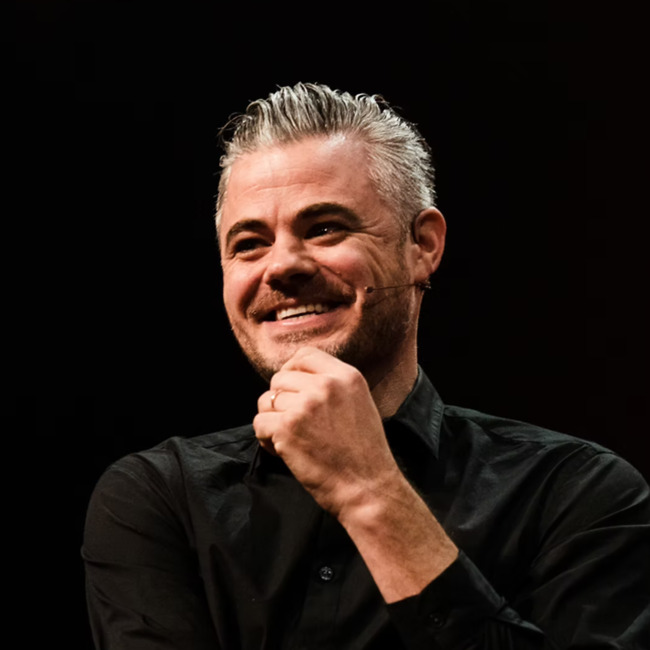
Scott Harrison
Founder and CEO of charity: water
Scott Harrison, the founder of Charity: Water, shares his incredible journey from being a successful nightclub promoter to becoming a global advocate for clean water. In this podcast, Scott discusses the global water crisis affecting 771 million people, the challenges and rewards of running a nonprofit organization, and the life-changing impact of Charity: Water. Discover how storytelling, creativity, and innovation have helped bring clean water to millions and what continues to drive Scott’s mission for change.
Podcast Episode · Beyond Speaking · Oct 8, 2024 · 23m
Scott: One out of ten human beings alive. It's 771 million people. This is two United States worth of people drinking unsafe contaminated water, risking their lives simply because of the conditions they were born into. You know, I didn't choose to be born into a middle class family in Philadelphia and 770 million people didn't choose to be born in these areas of the world with water poverty.
So I think when I came back, the first thing I did was just blow up my photos, take over galleries, host events, and show people what was actually happening out there.
Intro: Welcome to the Beyond Speaking podcast from Premier Speakers Bureau, featuring in-depth conversations with the world's most in-demand keynote speaker.
Brian: Hi, I'm Brian Lord. Welcome to the Beyond Speaking podcast. Today we've got Scott Harrison. Scott is the author of the book Thirst. He is the founder of Charity Water, a photojournalist, Mr. Creativity, one of Forbes' 40 under 40, and also just somebody who just wins creativity and innovation awards all the time. So, Scott, thank you so much for joining us here on the Beyond Speaking Podcast.
Scott: It's fun to be back. I think we did this five years ago. Almost five years ago.
Brian: I know it's crazy. And you've moved around a lot. And one of the things that's always hard to track down with speakers is moving around. And you're one of those people, you're a New Yorker at heart. And now you've come down here to the south. I'm not from the south either and it seems like everybody's coming here. What is it like that transition moving here and coming and being part of this new place?
Scott: Yeah, well I moved to Manhattan when I was 18 and I was gonna you know live my life and die in Manhattan. I had my kids there, I was gonna raise kids in Manhattan and I was like the frog over 26 years that just woke up one day and like I'm boiling. And I think COVID was was a big awakening for us. We had our big headquarters in Manhattan. You know, I was paying an outrageous amount of rent for a two-bedroom, twelve hundred square feet, you know, kids in bunk beds.
And that was just all I knew. You know, I'd built the organization there, you know, JFK was my airport that I could get almost anywhere in one shot. And then everything changed during COVID and we wound up actually moving to a farm in Pennsylvania. So we had a very rural experience for eighteen months. Yeah. And then when the world opened up and I started, you know, flying again, that wasn't practical to drive two hours to an airport and we took a look at good old Nashville, Tennessee. And we came about eighteen months ago and have been loving it as a family.
Brian: Yeah, so if anyone's curious that is watching and listening, if you want the halfway point between a farm and Manhattan, it's and it's a little bit of country, a little bit of city.
Scott: It's natural, yeah. It has added some extra flights. We're at, what, May, and I'm on fifty flights this year. Because it's a lot of extra legs out of the airport. But then it's twenty five minutes from the gate to home. Well we couldn't do that in New York City.
Brian: We're glad to have you here. And so obviously, so we're gonna get into some of the things you know that you like to talk about leadership, you know, innovation, creativity, those sorts of things. But I think a lot of it comes to your story.
So obviously you've had this big transition here to Nashville. That's definitely not the biggest transition that you've had. So if you take us back maybe to, I don't know the start of the change of the story where, you're living the you know living the life in New York, you know, being Leonardo DiCaprio's stunt double and just being somebody who and I'm kidding about that.
Scott: We did actually date the same girl for a brief period of time. It's funny you mention that.
Brian: I did not know that part. It's funny what comes up in an interview.
Scott: Well, he's dated thousands of girls.
Brian: It's almost hard not to, I think it is but but anyway, yeah, so so bring us back to that point of where you were.
Scott: Yeah, well, I moved to Manhattan at 18. I was really trying to rebel against a very conservative Christian upbringing. My mom became an invalid when I was four. So I grew up as an only child in a caregiver role, deeply involved in the church. And I wanted to be a doctor when I was growing up so that I could cure my mom and other people like her.
Instead, I became a nightclub promoter and just had this kind of obnoxious, cliche rebellion story. I woke up and said, now it's my turn. I want to drink, I want to smoke, I want to party, and I want to become rich and famous, and I want to drive a fast car and date girls on the cover of magazines. And there's actually a job where you can do all that. And it's called a nightclub promoter. And if you get good at that, you fill clubs in Manhattan full of rich and famous people. And the better you get at that, the more money you make.
And, you know, I remember kind of at the at the height of of you know career, I'd be up in the DJ booth with a bottle of champagne and Jay-Z at table one and Puff Daddy's at table three, and we're sitting at table two, you know, thinking we're in we're the kings of the world, as Jim Carrey and Denzel Washington and all these amazing people are kind of coming in and out of the club. It was a very shallow and hedonistic lifestyle. It's all about you, it's all about this image that you constantly have to keep up.
And after 40 nightclubs, I worked at 40 clubs in 10 years. It was just deeply exhausting. And at 28 years old, you know, I realized how far I'd come from the foundation of faith and spirituality that I've been brought up with morality. And if I died at 28, the only thing you could write on my tombstone would be “Here lies a man who got a million people wasted.” That was my only contribution to society, which you'd argue was a negative contribution to society.
So I'm a pretty radical guy. I come back to faith, I think, in a very different way as an adult, and I become really interested in service. And I asked myself the question, what would the opposite of my life look like? And I think I realized this pivot was not in order. A small course correction was not what was needed. It was like, how could I just say, do, and think the exact opposite? What's 180 degree? And the idea I came up with was taking one of the 10 years that I'd wasted and giving that back in service, one year of that. And I wanted to go to the poorest country in the world and see if I could be useful.
Well, I applied to a bunch of humanitarian organizations that I'd heard of, the World Visions and Save the Children's and doctors Without Borders of the World. I'm denied by the first ten organizations because it turns out they're not looking for nightclub promoters. And you know, these are serious humanitarian people doing serious humanitarian work.
But I was very fortunate that one organization said to me, if I was willing to pay them five hundred dollars a month, and if I was willing to go live in post-war Liberia, which interestingly at that time was the poorest country in the world because a 14-year war had just ended and it came on to the bottom of the United Nations development chart because they finally had data on the country. If I had paid and I was willing to live there, I could join a group of humanitarian doctors and surgeons as their photojournalist.
Well, I was not technically a photojournalist, Brian. I was a decent writer and I'd taken pretty decent pictures and I dusted off a degree at NYU that I'd never used in communications. And they took me and this just radically changed my life. Going from a life of excess and fashion and music and clubs to the poorest country in the world with no electricity, no running water, no sewage, no mail system, and one doctor for every 50,000 people just really upended my life.
And I signed up for a year. The year turned into two years. And among all the things that I saw while volunteering there, I'd spent time in leprosy colonies and spent time with the surgeons and the doctors. I had seen people drinking dirty water. I'd seen human beings drinking from brown viscous swamps. I'd seen kids drinking water that I knew was killing them in real time. And I don't know, was just the one thing that wasn't okay in my watch.
I think specifically I had been selling bottles of water for $10 in our clubs to people who wouldn't even open the water. They would just order 20 bottles and let it sit there as they drank, you know, champagne or vodka instead. And after the two years, at 30 years old, I came back with this clear kind of life's mission that I was gonna try to bring clean water to everybody on the planet or die trying. You know, or make as much of an impact as I could.
Brian: Yeah. That's amazing. And I'm curious to know what the reception was when you came back.
Scott: I mean, I think people were curious at first because it was so abrupt. If you were on my mailing list, and back then email open rates were like a hundred percent. This is the early days of the internet. you know, you would have gotten an invitation to the Prada megastore opening in Soho, New York on a Friday. And then two weeks later, I'm in Liberia sending you pictures of five thousand sick people waiting for our doctors, you know, in line. And, you know, there were certainly some unsubscribes, yeah, people who had not opted in for that kind of content.
But I learned that the same skill of storytelling and promoting, albeit I'd been promoting, you know, the velvet rope or the mystique of a club, those skills could be used to promote something that was redemptive and actually mattered in the world.
So people began to give money. They began to follow these stories, they began to forward them. The list began to grow as more and more people learned about it. I think they were really curious. So when I came back to New York after the tour, people said, How can I help? What are you gonna do next? We wanna be a part of this.
Brian: And what made you, you know, because I mean you've said this before, most people aren't looking for water. They're you know, that's not something that's sort of the calling card for what people wake up for in the morning because we don't experience that. How is that like telling that story? What was it trying to go from what you'd seen to what you wanted to accomplish?
Scott: Yeah. Well, I was a visual storyteller, so I came back with 50,000 photographs that I had taken over that time. And, you know, it's one thing to tell someone about a child or a family drinking dirty water. I mean, that's so abstract. You know, no one listening today, you know, woke up this morning and said, my gosh, I'm so grateful for the water that I'm brushing my teeth with, or the water that I'm taking to the gym.
So I think it starts with just being able to visually share the problem. And you know, people are really arrested by the fact that 10% of the world is drinking disgusting water today. You know, 10%, one out of 10 human beings alive. It's 771 million people. This is two United States worth of people drinking, you know, unsafe contaminated water, risking their lives simply because of the conditions they were born into. You know, I didn't choose to be born into a middle class family in Philadelphia, and 770 million people didn't choose to be born in, you know, these areas of the world with water poverty.
So I think when I came back, the first thing I did was just blow up my photos, take over galleries, host events, and show people what was actually happening out there. And there was an authenticity or a power of me being the eyewitness. You know, this wasn't secondhand information. I had walked in these villages. These were my photos. I had lived there for two years. And I was just inviting people to learn more about this issue and then to be a part of the solution.
And the great thing about water is it's completely solvable. There's not a single human being alive right now who we don't know how to help. There are vast amounts of incurable diseases where maybe we discover a cure in a lab someday after billions of dollars of research. Water's just not like that. I mean, we could get clean water to every single human being alive if we had the resources, if there was the will.
So what I've been at for the last 17 years is really trying to grow this global movement of people who will say, it's not okay. You know, not on my watch are people being deprived of the most basic need for human life.
Brian: And one of the things you've talked about too is that you were making a huge difference. Like there was the figure was coming down, the population's going up, and then of course we've got COVID. Can you kind of walk through what happened there?
Scott: Yeah, well, you know, over the years, I mean, you know, we were raising, you know, millions of dollars, then tens of millions of dollars, then hundreds of millions of dollars, really by engaging the public. So not government grants, not you know, corporate money. These were just everyday people who were responding to this need that Charity Water was out there, you know, talking about and and the values of transparency and innovation, and you know, we maybe we could talk about some of those things later.
But COVID happened. And you know, it was interesting what our partners did, so we work with 55 local partners across 29 countries. They all went into quarantine just like we did. But it was fascinating to see almost all of our well-drying well-drilling organizations and our hydrogeologists and all the people out there delivering clean water, they were all classified as essential frontline workers because, in a global pandemic, everybody's talking about global health and and water is the most basic building block.
And you know, I remember in the early days we're all washing our hands and our hands kids frantically and we're leaving our Amazon boxes outside and you know wiping them down. Well, 10% of the world can't wash their hands. 10% of the world doesn't have access to basic hygiene. So, you know, charity water actually leaned into some of that messaging. And our partners were out there with masks on, drilling wells. We moved some of our work to health clinics.
You know, it's shocking, but millions of health clinics around the world don't have water. Imagine going into a hospital and you're taking your medicine with dirty river water. So we really focused some of our efforts on making sure, you know, we were using our resources to bring health clinics access to clean water. And we had, you know, an incredible year during COVID. I mean, I think we all were prepared for the worst and our donor community stepped up. We raised almost a hundred million dollars.
Brian: That's amazing. That's amazing. And kind of scooting back a little bit and getting into that more the innovation, the practical side of things, where did storytelling start for you? I know you said you're a visual storyteller. Did that start when you was like a skill you built being a club promoter, or was that something that you came by even earlier?
Scott: I mean, I think I was a little bit of a young entrepreneur. I would have, I mean, I would market my little leaf blowing business, or I would go door to door and sell Christmas cards, or I was always trying to, you know, hustle to have a little bit of money that was my own, that I could have autonomy spending.
You know, during the clubs, I was always thinking about how do we differentiate. I mean, this is Manhattan. There's nine million people. People could go anywhere they want. So how could I convince them that spending $25 on a cocktail that only cost 25 cents to make, you know, should be done in our venue, that they should cue up in line for an hour outside the velvet rope so someone behind one-way glass could turn them away. So that was an exercise in storytelling and creating novelty and mystery about what happened inside.
And we would do these elaborate parties where we would throw a pool party. And, you know, I'd hire people and put in big lifeguard chairs and get a hundred beach balls, you know, and everybody would come in their bathing suits to the club. And you step into this giant pool party. We would do white parties. We would, you know, we would always look for that hook for why people would want to keep coming back and what would make it different from all of our competitors.
Brian: And how did you apply that in the sort of the nonprofit space? You know, you start charity water and you know as a leader as an entrepreneur from you know sort of this nonprofit entrepreneur. Where did that start and how did you build storytelling into it?
Scott: Well, I remember coming back and the only people I knew when I started Charity Waters, this is 17 years ago, were people that went to nightclubs and they worked at Sephora or MTV or Chase Bank. So I was just running around with my laptop and I would go into a club and I would go up to the DJ booth and in between his sets, I would open up my laptop and I would click next a hundred times and I would show him what I saw. And I would show him the solutions and I'd show them people getting clean water and lives being transformed. And then I would ask him for money. Or I'd ask him to play an event for free.
So I was just constantly pitching. I mean, I would probably give, you know, somewhere between five and ten presentations every single day. And, you know, sometimes he'd, you know, kick me out of the DJ booth and say, Bro, you're killing my buzz. Okay, okay. Like, can we talk about this tomorrow? Yeah. Whatever you need.
And then that kind of grew to you know to larger stages. And you know, I've probably given, I don't know, over 500 talks now. And it's being able to share the story in a visual way. You know, in a 30-minute talk, I'm gonna show more than a hundred images and videos trying to just immerse people into this idea.
So yeah, I think you know that is the most critical thing to running an organization of quick growth is you have to tell story after story in a wildly compelling way. You have to bring people into it, allow them to see themselves in the narrative, and then show them exactly what they can do to be a part of it.
Brian: Mm-hmm. And that's one of the things that's kind of fascinating, just just looking back at all this. I mean, so you've got these corporations and they're they've had a CEO or they've had a former NFL player or they've had somebody who's climbed out Everest. And then they have you. So like why do you think companies bring you in to speak?
Scott: Yeah, I mean we were talking about this. I mean, the diversity of, you know, from the banking conferences to the biotech to technology to you know, things that have absolutely nothing to do with either philanthropy or water even.
Look, people want to be inspired. They want to you know, they want to believe in great movements, they want to believe in You know, the best of themselves sometimes. So, you know, as we talk about the ch I mean, it's it's very much hero's journey idea. Charity Water's not the hero in the story. I'm not the hero. It's we're the guide.
So we tell story after story of these unbelievable people who will do something remarkable. And some of these stories are, you know, there's a little girl in Vancouver who did 12 lemonade stands for charity water. And in the rain, in the pouring rain, she would not bring her lemonade stand in because she was so passionate. And she sold like fifty-six hundred dollars worth of lemonade.
There was a nine-year-old girl that donated her birthday to charity water. And instead of throwing herself a birthday party, instead of accepting gifts, she wanted to raise $300 to help 10 people get water. You know, I mean, even that is inspiring. I mean, a nine-year-old is supposed to want gifts and a party and to be celebrated. But she had learned that there were kids that didn't even have water, you know, living a world away. And she donates her birthday and she falls a little short. She raises $220. And you know, her name was Rachel. She was bummed. She was like, I have let a few people down and I'm gonna try harder next year. And you know, she was kind of determined to reach her goal the next year.
And sadly, after her birthday, she was killed in a terrible car crash. There was a 20-car pile up on the interstate. She was actually the only fatality. She was in the backseat and her mom was driving. And she never got to run that second campaign.
But you know, the news spread of this little nine-year-old girl who cared about others, people she'd never met. And people from her church community started donating nine dollars, and then people from the Seattle community, it went out on the radio and they started donating nine dollars, and then it spread to the New York Times and the morning shows, and then it spread to Europe and it spread down into Africa. And people in Kenya and Tanzania and Malawi were going online, donating $9 in her memory.
And she wound up raising over $1.4 million. Inspiring 60,000 strangers to give. She then inspired so many other people to donate their birthdays and follow her lead. They raised more than $2 million, and you know, her impact was exponential.
So, you know, there are dozens and dozens of stories like that where everyday people, you know, do something, you know, sometimes it's not even remarkable, but that just has this global reach. So it's it's you know, it's fun to tell those stories and everybody can relate to a nine-year-old girl, everyone can relate to compassion or empathy and care for others.
Brian: Absolutely. Well thank you, Scott, for coming on and sharing your message and being a part of this Beyond Speaking podcast.
Scott: Yeah, thanks for having me.
Outro: Thank you for joining us for the Beyond Speaking podcast. To learn more about today's guests, visit PremiereSpeakers.com. Make sure to subscribe and leave a review wherever you listen.