Jessica was the highest-rated speaker at our annual conference. She rocked the house!


Premiere Exclusive
Dr. Jessica Kriegel
CEO Advisor and Doctor of Leadership, Best-selling Author
Profile Links
Fee Range
Please contact us for pricingTravels From
Sacramento, CA
Dr. Jessica Kriegel
Biography
Dr. Jessica Kriegel is a #1 USA Today bestselling nonfiction author, change strategist, and a leading voice on how modern leaders drive transformation that gets results. She is a frequent national media contributor, appearing on CNN, CNBC, Fox Business, and The TODAY Show, where she offers insight on change, performance, and the evolving demands of leadership in uncertain times.
As Chief Strategy Officer at Culture Partners, Jessica leads global research and advisory work focused on a defining challenge: how to activate change that produces measurable results. She challenges outdated models of control and compliance, advancing a rigorous framework built on ownership, belief shifts, and accountability.
Her bestselling book, Surrender to Lead, explores the paradox at the heart of high performance: sustainable results don’t come from tightening control, but from knowing what to release. Her earlier book, Unfairly Labeled, disrupted generational stereotypes and established her as a research-backed authority on leadership and organizational change.
Jessica also hosts the CEO Daily Brief, a five-minute daily podcast where business pragmatism meets inner wisdom, helping leaders act with clarity to drive results.
In addition to her business credentials, Jessica is a trained death doula. Sitting with individuals at the threshold between life and death has deepened her understanding of fear, meaning, and the illusions of control, shaping her conviction that real leadership begins where ego ends. That perspective informs her work on change: courage over comfort, presence over panic, and conviction over control.
She holds a doctorate in leadership, an MBA, and is currently pursuing a Master of Divinity.
Dr. Jessica Kriegel
Featured Videos
Current: Jessica Kriegel Surrender to Lead
Time 03:02
More Videos From Dr. Jessica Kriegel
Dr. Jessica Kriegel
Featured Keynote Programs
Surrender to Lead
The New Leadership Paradigm for an Unpredictable World
The old leadership model of controlling more, pushing harder, and knowing all the answers has reached its limits. In a world shaped by volatility, AI disruption, and cultural fragmentation, the leaders who thrive aren’t the ones gripping tighter. They’re the ones who surrender—not in weakness, but in wisdom.
Based on Dr. Jessica Kriegel’s groundbreaking book Surrender to Lead, this keynote introduces a transformative, counter-intuitive leadership framework for unlocking adaptability, clarity, and resilience. Through powerful storytelling, research-backed insights, and a practical roadmap for application, Jessica shows how surrender is not giving up—it’s giving way to better leadership.
Participants learn how to stop fighting reality, break out of fear-based decision loops, shift their mindset from control to clarity, and take aligned action that propels teams forward. This keynote is emotional, energizing, and deeply practical. It is perfect for organizations facing uncertainty, disruption, or rapid change.
Takeaways:
- Why Surrender is the most underestimated leadership skill of the next decade
- The SHIFT™ framework: a five-step method for leading with clarity, alignment, and accountability
- How surrender unlocks accountability across all levels of teams
- A new model for leadership effectiveness that aligns purpose, strategy and culture
Results-Based Leadership
The Framework for Turning Strategy Into Real Results
In today’s fast-moving environment, vision isn’t enough. Leaders must deliver outcomes. This keynote introduces Jessica’s results-driven methodology rooted in the Results Pyramid™ and the Four Steps to Accountability—a proven framework used by organizations globally to strengthen clarity, alignment, and ownership.
With humor, research, and powerful case studies, Jessica explains how beliefs drive actions, actions drive results, and leaders must intentionally shape each layer to create the culture their strategy requires. This keynote equips leaders at every level with a practical toolkit for transforming accountability from a buzzword into a lived reality.
Takeaways:
- A clear, actionable framework to connect employees to business results
- How to create clarity around expectations at every level of the organization
- The four steps to accountability—and how to hardwire them into daily habits
- Tools to align beliefs, behaviors, and systems to drive consistent performance
Leading Change
The Change Activation Equation
A Practical, Science-Backed Formula for Transforming Your Organization
Change is hard when it’s approached emotionally, but change becomes predictable when done right. Backed by original Stanford research, the Change Activation Equation reveals three quantifiable variables that predict whether change will succeed or stall.
Through data science, unforgettable stories, and a simple four-step process, Jessica shows organizations how to build alignment across teams, accelerate transformation, and eliminate the cultural friction that slows progress. This keynote is perfect for organizations undergoing reorganization, digital transformation, AI integration, strategic shifts, or rapid scaling.
Takeaways:
- The three variables that determine whether transformation takes root
- A four-step model to lead change from any seat in the organization
- How to avoid the cultural traps that derail even well-designed strategies
- A roadmap for becoming a champion of Change Activation
Ignite a Culture of Accountability
How to Get People to Give a Sh*t—Without Fear, Force, or Micromanagement
Accountability isn’t about consequences, it’s about ownership. This energizing keynote, inspired by Jessica’s viral TEDx Talk, reveals the counterintuitive truth about what actually makes people care. Hint: it’s not pressure, policies, or perks.
Jessica breaks down the psychology of ownership and teaches leaders how to inspire, not enforce, accountability. Attendees learn how to apply empathy, clarity, and shared purpose to transform disengagement into dedication. Whether you want to motivate teams, increase follow-through, or strengthen collaboration, this keynote delivers a powerful, practical blueprint.
Takeaways:
- Why traditional accountability systems fail, and what actually works
- A two-part strategy for building ownership and strengthening culture
- Practical tools for igniting passion, engagement, and follow-through
- The Four Steps to Accountability—applied to real organizational challenges
Dr. Jessica Kriegel
Featured Books
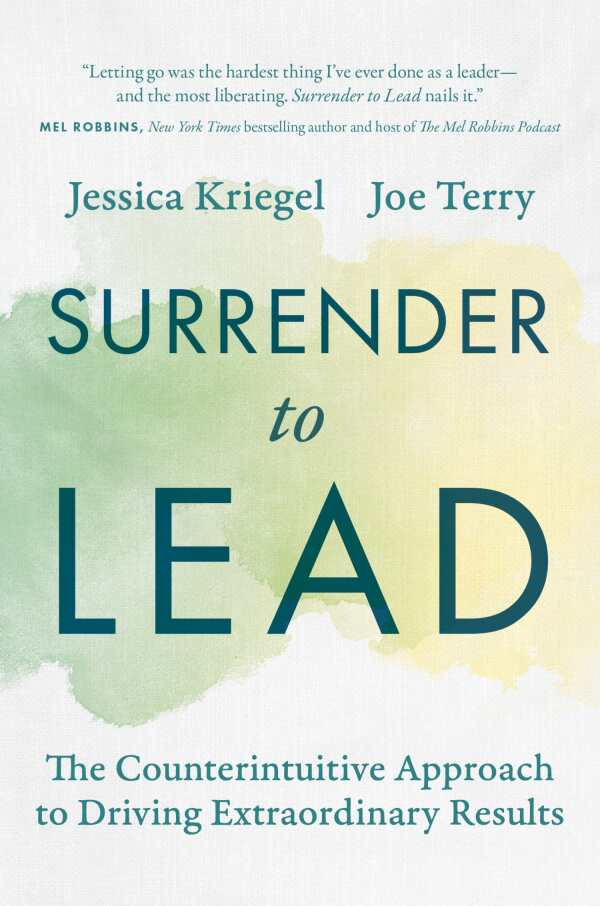
Surrender to Lead: The Counterintuitive Approach to Driving Extraordinary Results
by Dr. Jessica Kriegel
Unlock the power of surrender with the Results Equation.
When it comes to leadership, the idea of total control can be seductive. But it may also be what's holding you and your team back from achieving extraordinary results.
Motivated by fear, leaders too often become caught in the Action Trap, a bias toward top-down directives and management that may produce short-term gains but ends up stifling adaptability--the most important engine of growth.
Drawing on decades of experience and extensive research, including a study of 243 companies in collaboration with Stanford Graduate Business School, corporate culture transformation experts Joe Terry and Jessica Kriegel have found a solution.
Through intimate storytelling and real-life examples, they reveal the Results Equation (Purpose + Strategy + Culture = Results), a powerful new way of thinking about leadership based in love rather than fear that has proven to:
• Drive more than 4X revenue growth
• Improve clarity, alignment, and accountability
• Foster a culture of adaptability and continuous improvement
The most important key to this approach is also the most counterintuitive--surrender. Not surrender as in quitting, but surrendering the need for control to a focus on creating the conditions for greatness by creating experiences that change how people think and, ultimately, how they act.
If you're looking to revolutionize the way your team works and supercharge your results in a scalable and repeatable way, Surrender to Lead is your blueprint to getting better by letting go.

Proving the Value of Soft Skills: Measuring Impact and Calculating Roi
by Dr. Jessica Kriegel
A Step-by-Step Guide to Showing the Value of Soft Skill ProgramsAs organizations rise to meet the challenges of technological innovation, globalization, changing customer needs and perspectives, demographic shifts, and new work arrangements, their mastery of soft skills will likely be the defining difference between thriving and merely surviving. Yet few executives champion the expenditure of resources to develop these critical skills. Why is that and what can be done to change this thinking?For years, managers convinced executives that soft skills could not be measured and that the value of these programs should be taken on faith. Executives no longer buy that argument but demand the same financial impact and accountability from these functions as they do from all other areas of the organization.In Proving the Value of Soft Skills, measurement and evaluation experts Patti Phillips, Jack Phillips, and Rebecca Ray contend that efforts can and should be made to demonstrate the effect of soft skills. They also claim that a proven methodology exists to help practitioners articulate those effects so that stakeholders' hearts and minds are shifted toward securing support for future efforts.This book reveals how to use the ROI Methodology to clearly show the impact and ROI of soft skills programs. The authors guide readers through an easy-to-apply process that includes: -business alignment-design evaluation -data collection -isolation of the program effects -cost capture-ROI calculations-results communication. Use this book to align your programs with organizational strategy, justify or enhance budgets, and build productive business partnerships. Included are job aids, sample plans, and detailed case studies.

Unfairly Labeled
by Dr. Jessica Kriegel
A blueprint for managing people, not generations
Unfairly Labeled challenges the very concept of generational differences as an unfair generalization, and offers a roadmap to intergenerational understanding. While acknowledging that generational stereotypes exist, author Jessica Kriegel argues that they are wrong--and that it's unreasonable to assume that the millions of people born in the same 20-year time span are motivated by the same things, attracted to the same things, and should be dealt with in the same way. Kriegel's experience as Organizational Developer at Oracle puts her squarely in the talent strategy realm, where she works to optimize leadership development, team effectiveness, and organizational design. Drawing upon her experiences with workers of all ages and types, she shows how behaviors know no generational boundaries and how to work with people based on their talents, strengths, and weaknesses rather than simply slapping on a generational label and fitting them into an arbitrary slot.
There are 80 million Millenials in America, yet there are myriad books on managing Millenials and working with Millenials and the problem with Millenials. This book shows that whether you're working with Millenials, Generation X, or Baby Boomers, age is not the issue--it's the interpersonal dynamics that matter most.
- Examine the concept of generational issues
- Explore the disparate reality of each 20-year generational span
- Learn to understand and work effectively with other generations
- Facilitate intergenerational understanding sessions
The human mind craves categorization, so the tendency to lump people together is natural. It may, however, be holding your organization back. The members of each generation have only one thing in common--their age--and even that varies by two whole decades. Why assume that they should all be managed the same way? Unfairly Labeled shows you a better way, and provides a roadmap to a more effective organizational strategy.
Dr. Jessica Kriegel
Featured Reviews
Dr. Jessica Kriegel
Featured Articles & Resources
Coffee Badging May Be The Secret Driver To Unprecedented Employee Engagement
Let’s dive into an intriguing workplace phenomenon known as “Coffee Badging.” This trend is reshaping the traditional office attendance model, and it’s something every CEO and...
Unpacking the Remote Work Premium: The Dollars and Sense of Working from Anywhere
Earning roughly $6000 without leaving your home sounds pretty good.
Meet Emilie Bergstrom, a vibrant 28-year-old with a passion for making a difference. Just a few years ago,...
Trust Over Surveillance: A Lesson from Dropbox’s CEO on Remote Work
As the world cautiously inches back towards in-person work, Dropbox’s CEO, Drew Houston, offers a fresh and unconventional perspective that challenges the prevailing norms of...
Frequently Asked Questions
Quick answers to some of the most common questions about booking Dr. Jessica Kriegel for your event.
How do I book Dr. Jessica Kriegel for my event?
Booking Dr. Jessica Kriegel with Premiere Speakers Bureau is a streamlined 4-step process:
- Availability Check: Contact us with your event date and budget to verify if your desired speaker is available.
- Hold Date: We place a temporary "hold" on the speaker's calendar while you finalize internal approval.
- Contracting: We issue a contract outlining the fee, cancellation policy, and event expectations.
- Logistics: Once signed, our event management team handles all travel booking, itinerary, and AV requirements.
Why should I partner with Premiere Speakers Bureau rather than contacting speakers directly?
Partnering with Premiere Speakers Bureau provides a comprehensive safety net for your event that direct booking cannot match. You get the same speaker for the same price, but with a dedicated team with over 30 years of event experience handling contracts, logistics, and are prepared for any emergency. We know what it takes to run an excellent event.
What makes Premiere Speakers Bureau unique compared to other agencies?
Premiere Speakers Bureau distinguishes itself by having over 30 years of experience while partnering with more than 35,000 events. PSB has also built a streamlined, fully online process that makes booking a speaker, handling travel and payments extremely easy for anyone looking to plan a speaker led event.
How does Premiere Speakers Bureau's 'Zero Cost Service' model work?
Premiere Speakers Bureau operates on a 'Zero Cost Service' model for event planners. Our services—including research, booking, and logistics—are always free to the client. The speaker covers our commission from their standard honorarium as payment for our role in marketing and managing their engagements.
How are speaker fees structured, and what is typically included?
A speaker's fee typically covers the keynote presentation, a pre-event planning call, and standard customization. Travel expenses are usually billed separately.
What are the standard policies for speaker travel and expenses?
Travel expenses are negotiated during contracting. We generally recommend a flat travel fee for simplicity, though we also offer line-by-line invoicing when preferred. PSB ensures these expenses adhere to professional standards, and our Event Portal allows for easy tracking and invoicing.
Dr. Jessica Kriegel's Featured & Related Topics
Popular Speakers

Daymond John
Founder/CEO of FUBU, Presidential Ambassador for Global Entrepreneurship, Star of ABC's Shark Tank and CEO of The Shark Group

Valorie Burton
Best-Selling Author, President and CEO of The Coaching and Positive Psychology (CaPP) Institute, Personal and Executive Coach and International Speaker

Dr. Ben Carson
Former US Secretary of Housing and Urban Development / Conservative Political Thought Leader / Renowned Pediatric Neurosurgeon
Dr. Jessica Kriegel
CEO Advisor and Doctor of Leadership, Best-selling Author

Ryan Leak
Inspiring Workplace Cultures Rooted in Values, Passion and Risk-Taking

Deion Sanders
Pro Football Hall of Famer, Two-Time Super Bowl Champion and Coach

Earvin “Magic” Johnson
Five-Time NBA Champion, Entrepreneur

Liz Bohannon
Top 1% VC-Backed Female Founder & CEO and Bestselling Author of Beginner’s Pluck: Build Your Life of Purpose & Impact Now