Surrender to Lead dismantles the illusion of control and invites people to embrace humility, trust, and love as catalysts for powerful transformation.


Premiere Exclusive
Dr. Jessica Kriegel
#1 USA Today Bestselling Author of Surrender To Lead and Leadership Expert
Profile Links
Fee Range
Please contact us for pricingTravels From
Sacramento, CA
Dr. Jessica Kriegel
Biography
Dr. Jessica Kriegel is a #1 USA Today bestselling nonfiction author, change strategist, and a leading voice on how modern leaders drive transformation that gets results. She is a frequent national media contributor, appearing on CNN, CNBC, Fox Business, and The TODAY Show, where she offers insight on change, performance, and the evolving demands of leadership in uncertain times.
As Chief Strategy Officer at Culture Partners, Jessica leads global research and advisory work focused on a defining challenge: how to activate change that produces measurable results. She challenges outdated models of control and compliance, advancing a rigorous framework built on ownership, belief shifts, and accountability.
Her bestselling book, Surrender to Lead, explores the paradox at the heart of high performance: sustainable results don’t come from tightening control, but from knowing what to release. Her earlier book, Unfairly Labeled, disrupted generational stereotypes and established her as a research-backed authority on leadership and organizational change.
Jessica also hosts the CEO Daily Brief, a five-minute daily podcast where business pragmatism meets inner wisdom, helping leaders act with clarity to drive results.
In addition to her business credentials, Jessica is a trained death doula. Sitting with individuals at the threshold between life and death has deepened her understanding of fear, meaning, and the illusions of control, shaping her conviction that real leadership begins where ego ends. That perspective informs her work on change: courage over comfort, presence over panic, and conviction over control.
With a doctorate in leadership, a master’s degree in business, a second master’s in social transformation, and a Master of Divinity underway, she has yet to find the point at which she’s learned enough.
Dr. Jessica Kriegel
Featured Keynote Program
Surrender to Lead
Our culture teaches us that leadership means control, certainty, and strength. But the gospel tells a very different story. The life and teachings of Jesus Christ reveal that true leadership begins with surrender—trusting God more than our own plans, and allowing Him to transform us from the inside out.
In this powerful keynote, #1 bestselling author Jessica Kriegel shares the story behind Surrender to Lead and the moment that changed the course of her life. After years of identifying as an atheist and believing success came through self-reliance, Jessica experienced what she describes as a modern-day “burning bush” moment that led her to place her faith in Jesus Christ. That encounter revealed a truth she now shares with audiences everywhere: the very thing we resist—surrender—is often the doorway to the life God is calling us to live.
Drawing from Scripture, personal testimony, and her experience advising leaders around the world, Jessica explores why surrender is so difficult and why it is essential to the transformation God wants to do in us. Audiences will discover how releasing control and trusting Jesus can bring freedom, clarity, and purpose not only to our personal lives, but to the way we lead, serve, and impact others.
Through honesty, humor, and practical insight, Jessica challenges audiences to rethink leadership through the lens of faith—and to discover the strength that comes from surrendering fully to Christ.
Dr. Jessica Kriegel
Featured Books
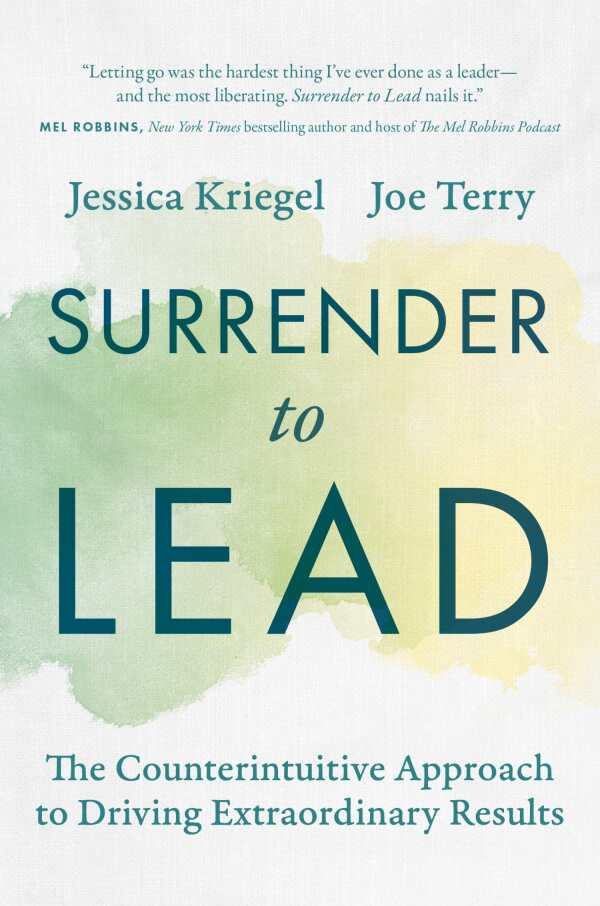
Surrender to Lead: The Counterintuitive Approach to Driving Extraordinary Results
by Dr. Jessica Kriegel
Unlock the power of surrender with the Results Equation.
When it comes to leadership, the idea of total control can be seductive. But it may also be what's holding you and your team back from achieving extraordinary results.
Motivated by fear, leaders too often become caught in the Action Trap, a bias toward top-down directives and management that may produce short-term gains but ends up stifling adaptability--the most important engine of growth.
Drawing on decades of experience and extensive research, including a study of 243 companies in collaboration with Stanford Graduate Business School, corporate culture transformation experts Joe Terry and Jessica Kriegel have found a solution.
Through intimate storytelling and real-life examples, they reveal the Results Equation (Purpose + Strategy + Culture = Results), a powerful new way of thinking about leadership based in love rather than fear that has proven to:
• Drive more than 4X revenue growth
• Improve clarity, alignment, and accountability
• Foster a culture of adaptability and continuous improvement
The most important key to this approach is also the most counterintuitive--surrender. Not surrender as in quitting, but surrendering the need for control to a focus on creating the conditions for greatness by creating experiences that change how people think and, ultimately, how they act.
If you're looking to revolutionize the way your team works and supercharge your results in a scalable and repeatable way, Surrender to Lead is your blueprint to getting better by letting go.

Proving the Value of Soft Skills: Measuring Impact and Calculating Roi
by Dr. Jessica Kriegel
A Step-by-Step Guide to Showing the Value of Soft Skill ProgramsAs organizations rise to meet the challenges of technological innovation, globalization, changing customer needs and perspectives, demographic shifts, and new work arrangements, their mastery of soft skills will likely be the defining difference between thriving and merely surviving. Yet few executives champion the expenditure of resources to develop these critical skills. Why is that and what can be done to change this thinking?For years, managers convinced executives that soft skills could not be measured and that the value of these programs should be taken on faith. Executives no longer buy that argument but demand the same financial impact and accountability from these functions as they do from all other areas of the organization.In Proving the Value of Soft Skills, measurement and evaluation experts Patti Phillips, Jack Phillips, and Rebecca Ray contend that efforts can and should be made to demonstrate the effect of soft skills. They also claim that a proven methodology exists to help practitioners articulate those effects so that stakeholders' hearts and minds are shifted toward securing support for future efforts.This book reveals how to use the ROI Methodology to clearly show the impact and ROI of soft skills programs. The authors guide readers through an easy-to-apply process that includes: -business alignment-design evaluation -data collection -isolation of the program effects -cost capture-ROI calculations-results communication. Use this book to align your programs with organizational strategy, justify or enhance budgets, and build productive business partnerships. Included are job aids, sample plans, and detailed case studies.

Unfairly Labeled
by Dr. Jessica Kriegel
A blueprint for managing people, not generations
Unfairly Labeled challenges the very concept of generational differences as an unfair generalization, and offers a roadmap to intergenerational understanding. While acknowledging that generational stereotypes exist, author Jessica Kriegel argues that they are wrong--and that it's unreasonable to assume that the millions of people born in the same 20-year time span are motivated by the same things, attracted to the same things, and should be dealt with in the same way. Kriegel's experience as Organizational Developer at Oracle puts her squarely in the talent strategy realm, where she works to optimize leadership development, team effectiveness, and organizational design. Drawing upon her experiences with workers of all ages and types, she shows how behaviors know no generational boundaries and how to work with people based on their talents, strengths, and weaknesses rather than simply slapping on a generational label and fitting them into an arbitrary slot.
There are 80 million Millenials in America, yet there are myriad books on managing Millenials and working with Millenials and the problem with Millenials. This book shows that whether you're working with Millenials, Generation X, or Baby Boomers, age is not the issue--it's the interpersonal dynamics that matter most.
- Examine the concept of generational issues
- Explore the disparate reality of each 20-year generational span
- Learn to understand and work effectively with other generations
- Facilitate intergenerational understanding sessions
The human mind craves categorization, so the tendency to lump people together is natural. It may, however, be holding your organization back. The members of each generation have only one thing in common--their age--and even that varies by two whole decades. Why assume that they should all be managed the same way? Unfairly Labeled shows you a better way, and provides a roadmap to a more effective organizational strategy.
Dr. Jessica Kriegel
Featured Reviews
Frequently Asked Questions
Quick answers to some of the most common questions about booking Dr. Jessica Kriegel for your event.
How do I book Dr. Jessica Kriegel for my event?
Booking Dr. Jessica Kriegel with Premiere Speakers Bureau is a streamlined 4-step process:
- Availability Check: Contact us with your event date and budget to verify if your desired speaker is available.
- Hold Date: We place a temporary "hold" on the speaker's calendar while you finalize internal approval.
- Contracting: We issue a contract outlining the fee, cancellation policy, and event expectations.
- Logistics: Once signed, our event management team handles all travel booking, itinerary, and AV requirements.
Why should I partner with Premiere Speakers Bureau rather than contacting speakers directly?
Partnering with Premiere Speakers Bureau provides a comprehensive safety net for your event that direct booking cannot match. You get the same speaker for the same price, but with a dedicated team with over 30 years of event experience handling contracts, logistics, and are prepared for any emergency. We know what it takes to run an excellent event.
What makes Premiere Speakers Bureau unique compared to other agencies?
Premiere Speakers Bureau distinguishes itself by having over 30 years of experience while partnering with more than 35,000 events. PSB has also built a streamlined, fully online process that makes booking a speaker, handling travel and payments extremely easy for anyone looking to plan a speaker led event.
How does Premiere Speakers Bureau's 'Zero Cost Service' model work?
Premiere Speakers Bureau operates on a 'Zero Cost Service' model for event planners. Our services—including research, booking, and logistics—are always free to the client. The speaker covers our commission from their standard honorarium as payment for our role in marketing and managing their engagements.
How are speaker fees structured, and what is typically included?
A speaker's fee typically covers the keynote presentation, a pre-event planning call, and standard customization. Travel expenses are usually billed separately.
What are the standard policies for speaker travel and expenses?
Travel expenses are negotiated during contracting. We generally recommend a flat travel fee for simplicity, though we also offer line-by-line invoicing when preferred. PSB ensures these expenses adhere to professional standards, and our Event Portal allows for easy tracking and invoicing.
Dr. Jessica Kriegel's Featured & Related Topics
Popular Speakers

Ryan Leak
Best-selling Author, Esteemed Executive Coach and Teacher

Dallas Jenkins
Creator, Director, and Co-Writer of The Chosen

Hannah Gronowski Barnett
Founder & CEO of Generation Distinct, Author, Speaker & Consultant

Annie F. Downs
Funny & Authentic Author, Speaker, Podcaster

Carey Nieuwhof
Host of Carey Nieuwhof Leadership Podcast / Leadership Expert

Bob Goff
New York Times Best-Selling Author of Love Does

Kirk Cameron
TV and Film Star

Jon Acuff
One of INC's Top 100 Leadership Speakers, New York Times Bestselling Author of Soundtracks, Finish and Do Over